<?xml version="1.0" encoding="UTF-8"?>
<feed xmlns="http://www.w3.org/2005/Atom">
  <title type="text">Emmett Till Memory Project</title>
  <updated>2026-08-27T17:07:02+00:00</updated>
  <generator uri="http://framework.zend.com" version="1.12.20">Zend_Feed_Writer</generator>
  <link rel="alternate" type="text/html" href="https://tillapp.emmett-till.org/"/>
  <link rel="self" type="application/atom+xml" href="https://tillapp.emmett-till.org/items/browse?output=rss2"/>
  <id>https://tillapp.emmett-till.org/</id>
  <author>
    <name>Emmett Till Memory Project</name>
    <uri>https://tillapp.emmett-till.org</uri>
  </author>
  <link rel="hub" href="https://pubsubhubbub.appspot.com/"/>
  <entry>
    <title type="html"><![CDATA[Mamie Till-Mobley and Emmett Till Memorial: A New Monument of Mamie Till-Mobley was unveiled in 2023. ]]></title>
    <summary type="html"><![CDATA[<p><strong><em>Situated in front of Argo Community High School, just west of Chicago in the Summit, IL, the Mamie Till-Mobley and Emmett Till Memorial captures the story of a mother in the act of becoming one of the twentieth century’s most important civil rights activists.</em></strong></p><img src="https://tillapp.emmett-till.org/files/fullsize/928c7b05a9425f737a851565f4f3eef6.jpg" alt="Mamie Till-Mobley Statue" /><br/><p>A new monument featuring Mamie Till-Mobley was unveiled on April 29th, 2023. Situated in front of Argo Community High School, just west of Chicago in Summit, IL, the Mamie Till-Mobley and Emmett Till Memorial captures the story of a mother in the act of becoming one of the twentieth century’s most important civil rights activists. The memorial captures Mamie’s resolute dignity—head held high, arm outstretched, smile on her face—as she fought for justice after the 1955 lynching of her 14-year-old son Emmett in Mississippi. It reminds the public of her tireless work confronting racism and summons them to carry on her work today.</p><p>For over 40 years, Mamie fearlessly toured the country sharing Emmett’s story and rallying support for legislation against lynching. She returned repeatedly to Argo High School, her alma mater, to implore students to use their voices for change. Her relentless activism continued until her death in 2003 at age 81.</p><p>Now, in a monument designed by Chicago artist Sonja Henderson, Mamie resumes her watch outside Argo High. The memory of Mamie’s prophetic voice fills the space, continuing to push the country towards change. </p><p>The centerpiece of the memorial is a statue of Mamie standing behind a richly adorned podium, Surrounding the statue are a series of miniature obelisks, each of which connect Mamie’s influence to sites around Chicago and around the country. One obelisk points visitors to Robert’s Temple Church of God in Christ—the site of Till’s funeral. Another points visitors to courthouse in Mississippi where Till’s murderers were acquitted. Still another points to his boyhood home, just .3 miles away. Together, the monument and the obelisks remind us that Mamie’s power may have started in Chicago, but it coursed across the nation. </p><p>The podium behind which Mamie stands is a work of art all its own. On its north side, a base-relief sketch portrays the seed barn on the Millam plantation in Mississippi where Till’s brutal lynching occurred. Henderson protects the observer from the scene’s horror by strategically placed cotton plants that obscure but unmistakably invoke the racial violence that occurred.</p><p>A base-relief vignette on the front of the podium celebrates the beauty, innocence, and humanity of Mamie and Emmett. It features a small pond with two unattended fishing poles symbolizing the eternal lives of Mamie and Emmett. A rarely seen photograph of Emmett rests at the center of the scene, portraying his youthful innocence and, as Henderson explains, positions his death as the catalyst for Mamie’s subsequent career as a civil rights activist.</p><p>A third vignette is on the south side of the podium. Co-created by Henderson and Chicago artist John Weber, the base relief completes the story, recounting Till’s funeral at Robert’s Temple on Chicago’s South Side. When Emmett's mutilated body was shipped home to Chicago, Mississippi authorities ordered the casket sealed. Yet Mamie demanded it unsealed, insisting, as the monument reminds us, "let the people see what I've seen." That bold act, along with the open-casket funeral and chilling photos in Jet magazine, catalyzed outrage across America.</p><p>Behind the podium, Mamie stands, courageous, yet peaceful, determined to achieve justice for her son and all who face the specter of racial injustice. Under her right hand, on the podium, lies a copy of Emmett Till Anti-Lynching Bill which was signed into law by President Joe Biden on March 29th, 2022, an achievement that reflects the enduring legacy of Mamie’s efforts.</p><p>The Henderson-designed memorial received recognition and commendation from the 117th U.S. Congress “as a catalyst for immediate and continued education of students at Argo Community High School as well as members of the Argo-Summit community around the issues of social justice and civil rights.”</p><p>From Argo High, Mamie’s spirit cries out for justice. Her immortalized figure insists the work begun here long ago must continue, demanding her heirs—today's youth—carry forth the movement to which she dedicated her life.  </p><p>Students pass beneath Mamie's resolute gaze, heading inside to classes where they matriculate, carrying hopes for the future—a future cut too short for young Emmett. In Mamie and her son, the past now walks tall beside students, linked arm in arm with each new generation, marching towards greater equality.</p><p><em><strong><a href="https://tillapp.emmett-till.org/items/show/25">For more (including 9 images) view the original article</a></strong></em></p>]]></summary>
    <published>2024-01-24T15:41:58+00:00</published>
    <updated>2026-04-17T19:39:38+00:00</updated>
    <link rel="alternate" type="text/html" href="https://tillapp.emmett-till.org/items/show/25"/>
    <id>https://tillapp.emmett-till.org/items/show/25</id>
    <author>
      <name>Theon Hill</name>
    </author>
  </entry>
  <entry>
    <title type="html"><![CDATA[Argo Corn Products:  How the Great Migration Shaped the Life of Emmett Till]]></title>
    <summary type="html"><![CDATA[<p><strong><em>A corn processing plant fueled the great migration, lured the Till family north, and created stability, if not equality, for the young Emmett Till.</em></strong></p><img src="https://tillapp.emmett-till.org/files/fullsize/8280eab54e85a628552e48326b29e88c.jpg" alt="Argo Corn Products from the east, 1936" /><br/><p>In 1923, Wiley Carthan left Mississippi on the Illinois Central Railroad, heading for Chicago. He settled just outside the Chicago city limits in the town of Argo, Illinois. Argo’s real name was Summit, but the largest corn processing plant in the world—the maker of Karo syrup, Bosco malted milk, Mazola cooking oil, and, critically, Argo Corn Starch—made Summit a company town, and locals called the place Argo. Carthan settled in and sent for his wife Alma and daughter Mamie, and the family made a life there. Mamie Carthan graduated with honors from the high school and soon married another Argo worker, Louis Till. In 1941, they had a son named Emmett. </p><p>The Argo plant shaped every facet of life in Summit. If locals called the town “Argo,” they called Argo the “university”—it was the place where boys went after high school. Emmett’s father, his stepfather, and many members of the Till family punched the clock at Argo. </p><p>Historians use the phrase “The Great Migration” to describe the early years of African American exodus out of the South to cities in the North. Of course, that movement really started with the underground railroad and continued through the rest of the 19th century. But the first mass migration came in the era of World War I and into the 1920s. For example, Chicago’s blacks made up 2% of the city’s population in 1910, 7% by 1930, and 25% by 1960. </p><p>Southern Jim Crow laws were firmly in place by 1900, depriving African Americans of the rights of citizens—voting, equal justice under law, trial by jury, etc. Few Southern blacks managed to acquire property, so share-cropping and tenancy kept most in penury. Schools, accommodations, transportation, and housing were all rigidly segregated, and black life was hedged in by a vicious system that enforced laws against vagrancy and other crimes with long sentences and brutal labor. And too, the lynching of blacks who “got out of line” added an element of terror to the indignities of Jim Crow. </p><p>Faced with such conditions, Pulitzer Prize-winning historian Isabel Wilkerson has written that “nearly every black family in America had a decision to make.” And scores upon scores did “what human beings looking for freedom, throughout history, have often done. They left.” The Carthans joined the throng of what was, in Wilkerson's words, a “back-against-the wall, reluctant yet hopeful search for something better.” </p><p>The World War I economy and the prosperity of the 1920s created new opportunities in the urban North. Word of these opportunities spread on the growing popularity of the <em>Chicago Defender</em>, a weekly newspaper with national circulation that repeatedly urged Southern blacks to leave their benighted homeland. The same railroad that carried Till to and from Mississippi carried the <em>Defender</em> to the rural South, bearing news of a brighter day in Chicago. </p><p>Equally important, African Americans voiced their resentment of American apartheid. The founding of the NAACP in 1909, for example, was a key moment of black politicization and resistance. The growing political resistance combined with industrial opportunities in the North lured the dispossessed to Chicago by the hundreds of thousands. </p><p>Corn Products made Argo a small boom town, attracting not only Southern blacks, but Poles, Slovaks, Russians, and Italians. African Americans got the worst jobs, but the work was steady, and the town prosperous enough to sustain a life far better than anything in Mississippi. Blacks founded their own churches, businesses, and neighborhoods. Like the town itself, Corn Products was not fully integrated but not rigidly segregated either, offering a margin of decency. Life got even better for workers when the union organized Corn Products in the late 1930s. The Argo Local of the Oil, Chemical and Atomic Workers Union brought better pay, benefits, overtime, and if not equality, at least a measure of dignity and security. </p><p>Before Till took the train to Mississippi in 1955, his family had its trials: Wiley Carthan left for Detroit, Louis Till abused his wife. But the modest prosperity provided by Corn Products made Till's hometown a more safe and secure environment than he might have experienced in Mississippi or on Chicago’s South Side.</p><p><em><strong><a href="https://tillapp.emmett-till.org/items/show/24">For more (including 4 images&#32;&amp;&#32;1 video) view the original article</a></strong></em></p>]]></summary>
    <published>2020-01-29T16:21:08+00:00</published>
    <updated>2026-04-17T19:39:38+00:00</updated>
    <link rel="alternate" type="text/html" href="https://tillapp.emmett-till.org/items/show/24"/>
    <id>https://tillapp.emmett-till.org/items/show/24</id>
    <author>
      <name>Elliott Gorn&amp;#32;&amp;amp;&amp;#32;Dave Tell </name>
    </author>
  </entry>
  <entry>
    <title type="html"><![CDATA[Till&#039;s Boyhood Home: Surrounded by family and friends from a young age, Till never outgrew his love for his boyhood community. ]]></title>
    <summary type="html"><![CDATA[<p><strong><em>Although the young Emmett moved from Summit to Detroit to Chicago, his heart was always in Summit. </em></strong></p><img src="https://tillapp.emmett-till.org/files/fullsize/7b1615f9bfae1daa78590e9bd69b00b3.jpg" alt="Memorial Bricks Support Scholarships for Local Kids" /><br/><p>On July 25, 2021, this site became a memorial. To participate in the memorial, and help fund the education of underpriviledged youth, contribute to the field of memorial bricks <a href="https://emmetttillscholarship.org/">here</a>. </p><p>We usually think of Emmett Till as a Chicagoan. He did live on the segregated South Side during his last few years, but most of his life was spent in Summit, Illinois, a tight-knit industrial community of 12,000 people just outside of Chicago.</p><p>On July 25, 1941, Emmett was born in Cook County Hospital in Chicago. Although his first home was a nearby Summit apartment, he moved to this lot (7526 64th Street) with his mother Mamie Till before the year was out. In 1947, Till’s cousin Wheeler Parker arrived from Mississippi and moved in next door (7524 64th Street). Till's first school was just a block west.</p><p>These were happy years. In her memoir, Mamie Till-Mobley spoke warmly of Summit, remembering, “Our whole neighborhood was like an extended family.” She described how African Americans had a strong sense of community centered around church, work, and family. Emmett, along with his best friend Wheeler, explored every bit of this community on foot and by bicycle. Even after Emmett and his mother moved to Chicago in 1950, he returned to Argo most weekends to see his friends and extended family.</p><p>Summit may have offered a tight-knit community, but it was also an industrial town. In fact, the southern half of the town was known by locals as “Argo,” the eponymous name of the company that owned the world’s largest corn processing plant. Just west of Archer St., the 30-acre plant produced Argo Corn Starch and shaped virtually every facet of life in Summit. As Mamie recalled, “Every day, the people in our little Argo community could see the Corn Products plant spread out there on the horizon, dominating our landscape. It stood there as a constant reminder that the gateway to a better life was hard work.”</p><p>During the World War I era and into the 1920s, the Argo plant was indeed a gateway. It attracted thousands of African Americans determined to escape the Jim Crow South. Argo (both the town and the company) offered jobs, schools, and neighborhoods that were not rigidly segregated. Although the streets north of 63rd were red-lined and closed to African Americans, 64th Street was integrated. To be sure, Argo was no racial paradise. But compared to the Deep South from which most migrants came, it was a big step up. The plant employed black laborers in the most dangerous and difficult roles, but they offered steady hours and decent pay. In the 1930s, the plant was unionized, and laborers enjoyed better protections still. Opportunities to vote, hold property, and educate children were far superior to what lay behind in the South. Even the local sports teams had black and white players.</p><p>After a short-lived adventure in Detroit, Mamie Till-Bradley, her new husband Pink Bradley, and the ten-year old Emmett left Argo for Chicago’s South Side in 1951. With a job downtown, Till-Bradley moved to 63rd Street and St. Lawrence, in a densely packed and rigidly segregated neighborhood near her son’s school. But Argo, more than Chicago, still felt like home. Emmett took the 63d Street streetcar back week after week, and his mother never worried about him there: “I knew he was in good hands. I knew the entire community was looking out for him. . . . Argo was a good fit for Emmett. . . . He would hang out with his friends all day on Saturdays and spend a good part of Sundays in Church, where, of course, he’d find his friends again. He lived for the fellowship. He lived for the fun. That most of all.” </p><p>Argo is still a home for Emmett. In 2009, under the leadership of Dr. Marvel Parker and Rev. Wheeler Parker, the home base of the Summit Community Task Force became the Emmett Till Memorial Center. Located a short block from here, at 6450 S. 76th Avenue, the building provides space for a range of community and justice-oriented activities. </p><p>On July 25, 2021, on Emmett Till's 80th birthday, the Task Force unveiled a commemorative sign and a field of commemorative bricks. Donors can buy the bricks to to support the Emmett Till Scholarship Fund.</p><p><em><strong><a href="https://tillapp.emmett-till.org/items/show/23">For more (including 9 images&#32;&amp;&#32;1 video) view the original article</a></strong></em></p>]]></summary>
    <published>2020-01-29T16:19:46+00:00</published>
    <updated>2026-04-17T19:39:38+00:00</updated>
    <link rel="alternate" type="text/html" href="https://tillapp.emmett-till.org/items/show/23"/>
    <id>https://tillapp.emmett-till.org/items/show/23</id>
    <author>
      <name>Elliott Gorn&amp;#32;&amp;amp;&amp;#32;Dave Tell </name>
    </author>
  </entry>
  <entry>
    <title type="html"><![CDATA[A Home in Chicago: Till&#039;s Ill-Fated Trip to Mississippi Began at This House]]></title>
    <summary type="html"><![CDATA[<img src="https://tillapp.emmett-till.org/files/fullsize/b6826fe75daf1d7047af205616506c11.jpg" alt="Emmett and Mamie Till-Mobley on the exterior of the house they lived in from 1950-1955. " /><br/><p>In November 1951, ten-year old Emmett, his mother Mamie Till-Bradley, and her new husband Pink Bradley moved into a two-flat home in the Woodlawn neighborhood on the south side of Chicago. </p><p>Less than two years earlier, Mrs. Till and Emmett had left their comfortable community in Argo for an adventure in Detroit. As Mrs. Till-Mobley (her final married name) tells the story in <em>The Death of Innocence</em>, she went to Detroit looking for love. She found Pink Bradley and married him in May of 1951. But Emmett never took to Detroit. He longed for the friends and family he left behind in Summit. By the time of the wedding, Emmett had moved back to the Chicago area on his own and was living with John Carthan, the younger brother of his grandfather Wiley Carthan. Till-Bradley had no interest in being so far away from her son. When her mother Alma Spearman purchased the two-flat home at 6427 S. St. Lawrence Street, she resigned her Detroit-area job and returned to Chicago to work as an Air Force clerk just south of the Loop. </p><p>Emmett, his mother, and, for a couple of months, Pink, lived on the three-bedroom second floor. Ollie Gordon lived in the garden apartment and an uncle lived on the first floor. Although the marriage to Pink was over by the end of 1952, the S. St. Lawrence Street home was good to her and Emmett. Just after moving in, Emmett began 5th grade at McCosh elementary school, an all-black school just a 5-minute walk from his home. </p><p>As Till-Mobley recalled, “Emmett controlled 64th and St. Lawrence. For a three-block stretch, this was his land. He knew every old person. He did grocery errands. He did lawns. He (shoveled) snow. He made $15 washing and painting a ladies’ hall, from the lower molding down to the floor.” 64th and St. Lawrence may have been Emmett’s “land,” but his heart was never totally in it. On weekends, Till would ride the 63rd-street street car back to the friendly confines of Argo. There he would find his cousin Wheeler and the friends with whom he spent his first nine years. </p><p>Till’s last journey from S. St. Lawrence Street was on the morning of August 20, 1955. He caught the 8:01am train at Englewood Station, barely two blocks from his house. The train was bound for the Mississippi Delta where Till would become the victim of one of America’s most ruthless lynchings. </p><p>In 2015, the home was bought by Alex Al-Sabah of Elite Invest for $47,500. Elite Invest evicted squatters and flipped the house, quickly selling it for $175,000 to a New Jersey investor named Brahmananda Bandela. Neither Al-Sabah nor Bandela were aware of the home’s history. In 2017, Preservation Chicago advocated that the home should be given Chicago Landmark status--a benchmark achieved in 2021. </p><p>In 2020, the home was purchased by Blacks in Green--an environmental and community revitalization nonprofit. With funding from the National Trust for Historic Preservation, they plan to open it as a community space in 2025. </p><p>While the home has never been commemorated, McCosh Elementary has fared better. Till attended McCosh Elementary from 1951 to 1955 (grades 5-8). In 2006, McCosh Elementary was renamed the Emmett Louis Till Math and Science Academy. Located at 6543 South Champlain Avenue, the school is now a magnet school for the fine and performing arts.</p><p><em><strong><a href="https://tillapp.emmett-till.org/items/show/22">For more (including 4 images) view the original article</a></strong></em></p>]]></summary>
    <published>2020-01-24T17:12:42+00:00</published>
    <updated>2026-04-17T19:39:38+00:00</updated>
    <link rel="alternate" type="text/html" href="https://tillapp.emmett-till.org/items/show/22"/>
    <id>https://tillapp.emmett-till.org/items/show/22</id>
    <author>
      <name>Dave Tell </name>
    </author>
  </entry>
  <entry>
    <title type="html"><![CDATA[Burr Oak Cemetery: Till&#039;s final resting spot has never been without drama]]></title>
    <summary type="html"><![CDATA[<img src="https://tillapp.emmett-till.org/files/fullsize/8140b541508b18acace2bf2dc62169d4.jpg" alt="Emmett Till Headstone" /><br/><p>Emmett Till’s funeral began shortly after his body came home to Chicago. The A. A. Rayner Funeral home opened its doors for the initial viewing on Friday, September 2. On Sunday, Till's body was moved to the Robert’s Temple of the Church of God in Christ for a deeply emotional service. The church remained open for two days as a steady stream of people came to pay their last respects—one hundred thousand of them, according to the police estimate. After final prayers on Tuesday morning, fifty cars followed Emmett’s hearse to the burial ground at Burr Oak Cemetery.</p><p>In midcentury Chicago, death was just as segregated as life. Burr Oak Cemetery was founded in 1927 in Alsip, Illinois, a suburb of Chicago, financed by prominent south-side businessmen as a final resting place for African-Americans. Famous contemporaries of Emmett Till were buried there including heavyweight boxing champion Ezzard Charles, songwriter/producer Willie Dixon, gospel singer Roberta Martin, and Dinah Washington, “the queen of the blues.”</p><p>It was warm even for early September when Emmett Till’s body was laid to rest in Burr Oak. Two hundred people gathered at the gravesite for one last round of tears and prayer and remembrance. His ground level marker read simply, “Emmett Till, In Loving Memory” along with the dates of his birth and death, and a tiny photo of him from Christmas, 1954. As the decades passed, Mamie Till-Mobley was increasingly dissatisfied with the conditions and upkeep of the grounds. Till's gravesite was often flooded, the headstone was broken by mowers, the picture was in tatters, and the vase designed to hold flowers would no longer stand upright. She longed to move the body to the beautiful Oak Woods Cemetery and established a fundraising campaign to make it happen.</p><p>In 2001, however, Burr Oak Cemetery came under new management. Under the direction of Carolyn Towns, the cemetery satisfied Till-Mobley with a promise to build a museum called the “Emmett Till Historical Museum.” The museum would honor the legacy of Emmett and provide a final resting spot for him, Till-Mobley, and her long-time husband Gene Mobley. It never came to pass.</p><p>In May 2004, nearly fifty years after his burial, the FBI reopened the Till case. The Cook County Medical Examiner set up a tent at Burr Oak Cemetery and exhumed Till’s body. The forensic exam determined that the body in Burr Oak Cemetery was in fact the body of Emmett Till. While this may seem obvious, it is important to remember that there was a dispute over the identity of the body that, in 1955, provided the jury the legal cover with which to acquit the murderers. Although Sheriff H. C. Strider indicated that Till was “colored” on the death certificate, he testified in trial that the body was so decomposed that he could not identify its race. This was willed ignorance, designed to provide a legal mechanism to let the murderers walk free. With this background, the 2005 exhumation takes on new importance. The forensic exam marked the end of Strider’s racist lie.</p><p>Three days after the FBI exhumed the body, they set the body in a new coffin and, in a private ceremony, reinterred the body. Because the long-promised Emmett Till Historical Museum had not yet come to pass, the family understood the reburial as a temporary measure. When the museum was complete, they believed Till’s body would be moved once more.</p><p>In July 2009, Carolyn Towns was charged with dismembering remains, reselling occupied plots, and stealing over $100,000 from the cemetery. She pled guilty to a range of charges in 2011 and began a twelve-year prison sentence in November of that year.</p><p>Although Till’s plot was not harmed by Town’s scheme, she had not cared for Till’s casket. Following the exhumation, the original casket sat in a neglected storage shed and was occupied by a family of possums. When it was discovered in 2009, the Till family took possession of the casket, had it restored at A. A. Rayner and Sons funeral home, and made plans to give it to Smithsonian’s National Museum of African American History and Culture.</p><p>Beautifully refurbished, that original coffin where Emmett’s body lay while one-hundred-thousand mourners passed by, where the famous photograph of his brutalized face was taken, where he rested for fifty years, now forms the centerpiece of the most moving display in the National Museum of African American History and Culture in Washington, D. C. With the coffin front and center, the visitor enters a room designed to look like the Roberts Temple did in September 1955.</p><p>While the original coffin has moved to Washington, D. C., Till remains in Burr Oak Cemetery, where he was first buried in 1955. The headstone is small and relatively unadorned, the museum remains unbuilt, but the gravesite is peaceful and open to public viewing.</p><p><em><strong><a href="https://tillapp.emmett-till.org/items/show/21">For more (including 6 images&#32;&amp;&#32;1 video) view the original article</a></strong></em></p>]]></summary>
    <published>2020-01-24T16:34:50+00:00</published>
    <updated>2026-04-17T19:39:38+00:00</updated>
    <link rel="alternate" type="text/html" href="https://tillapp.emmett-till.org/items/show/21"/>
    <id>https://tillapp.emmett-till.org/items/show/21</id>
    <author>
      <name>Elliott Gorn&amp;#32;&amp;amp;&amp;#32;Dave Tell </name>
    </author>
  </entry>
  <entry>
    <title type="html"><![CDATA[Robert&#039;s Temple Church of God in Christ : It was in Chicago that the Emmett Till lynching became a world-wide story ]]></title>
    <summary type="html"><![CDATA[<img src="https://tillapp.emmett-till.org/files/fullsize/1a5bbfe1683d2e97e5a91eb748ed1e3b.jpg" alt="Crowds outside Robert&#039;s Temple Church of God in Christ" /><br/><p>Hours after Till’s body was discovered protruding from the Tallahatchie River, Mississippi authorities began to bury the body—and the story—in a rural cemetery at a rural church deep in the Mississippi Delta. Had Till’s mother Mamie Till-Mobley not intervened and reclaimed her son’s body, Till’s lynching may have been recorded in the history books alongside the likes of George Lee and Lamar Smith. Like Till, Lee and Smith were lynched in Mississippi in the summer of 1955. Unlike Till, their stories have been largely forgotten. The difference in their respective fates can be traced to Mamie Till-Mobley's demand that the "world see" what happened to her son. It was at Robert’s Temple Church of God in Christ that the world saw. As Yvette Johnson wrote in the <em>Song and the Silence</em>, Mamie Till-Mobley changed the world with the open-casket funeral.</p><p>Upon arriving back in Chicago on the morning of September 2, 1955, the first stop for Till’s body was the A. A. Rayner Funeral home which, in 1955, was located at the corner of 41st and Cottage Grove. The casket arrived locked, sealed with the state seal of Mississippi, and accompanied by orders that the casket was not to be opened. If Mississippi authorities could not bury the body in a nameless cotton field, they hoped their seal would keep Till’s story under wraps. It did not work. </p><p>Till-Mobley disregarded the order and insisted that the casket be opened. It was at A. A. Rayner Funeral Home that she uttered the famous phrase: “Let the world see what they did to my boy.” Following Mamie's wishes, Rayner placed the body in the front room of their facility in a glass-topped casket. Over the next two days, as many as fifty thousand people would visit the funeral home to pay their respects.</p><p>Among the throngs at the funeral home was the photographer David Jackson. Jackson was a photographer for Johnson Publications, and Till-Mobley allowed him to be on the podium at the twelfth street station when Till’s body arrived. He then accompanied the body to Rayner and, when Till-Mobley opened the casket, he took a picture and published it in Johnson Publication’s leading outlets: <em>Jet</em> and the <em>Chicago Defender</em>. In a way that words could never do, Jackson’s photograph captured the sheer violence visited on the body—and especially the face—of Emmett Till. Although the brutality of the picture is difficult to describe, the words of John Edgar Wideman come close. He described a face “crushed, chewed, [and] mutilated.” A face “with all the boy, all the human being battered out of it.” Jackson’s photograph transformed the Till murder from one more 1955 Mississippi lynching into the unforgettable spark of the civil rights movement. Delta activist Amzie Moore may have put it best, claiming that the photograph made Till’s murder “the best advertised lynching I had ever heard.” </p><p>For black Chicago, however, the Jackson photograph was only the beginning. On Sunday, September 4th, the body was moved to the Robert’s Temple Church of God in Christ—the home congregation of Mamie Till and her mother Alma. The two-thousand seat auditorium was filled to capacity for the funeral, and several thousand more listened to the 90-minute service on loudspeakers set up outside the church. The sermon was given by Bishop Louis Ford, who used the funeral to call on President Eisenhower to “go into the Southern states and tell the people there . . . that unless the Negro gets full freedom in America, it is impossible for us to be leaders in the rest of the world.” He closed the sermon by announcing that the burial would be delayed until Tuesday and the body would lay in state for the next two days. </p><p>The following 48 hours saw an estimated one-hundred thousand mourners file past the body. </p><p>In 1991, Robert’s Temple Church of God in Christ underwent a major renovation. The iconic cross-shaped marquis was removed, a tan brick facade was installed over the top of the original storefront, an angular roofline hid the original curved profile, a drop-ceiling was installed, and the balcony was removed.</p><p>On March 29, 2006, Robert’s Temple was designated as a Chicago Landmark. The small plaque on the west side of the building is the only visible acknowledgement of the church’s key role in the Till story.</p><p><em><strong><a href="https://tillapp.emmett-till.org/items/show/20">For more (including 10 images&#32;&amp;&#32;1 video) view the original article</a></strong></em></p>]]></summary>
    <published>2020-01-24T16:12:06+00:00</published>
    <updated>2026-04-17T19:39:38+00:00</updated>
    <link rel="alternate" type="text/html" href="https://tillapp.emmett-till.org/items/show/20"/>
    <id>https://tillapp.emmett-till.org/items/show/20</id>
    <author>
      <name>Dave Tell</name>
    </author>
  </entry>
  <entry>
    <title type="html"><![CDATA[Emmett Till Interpretive Center: The Nonprofit that told Till&#039;s Story]]></title>
    <summary type="html"><![CDATA[<img src="https://tillapp.emmett-till.org/files/fullsize/2538cc6c067ffa0f7c498b4cd23c2a85.jpg" alt="Exterior of the Emmett Till Interpretive Center" /><br/><p>The Emmett Till Memorial Commission has done more for the memory of Emmett Till than any other organization in the world. Since its founding in late 2005, the Commission has transformed the landscape of Tallahatchie County. They have created a 9-site driving tour (10 sites if you count the Interpretive Center in Sumner) and renovated Sumner's Tallahatchie County Courthouse, the site of the 1955 Till trial.</p><p>The Emmett Till Memorial Commission was formed when economic opportunism momentarily aligned with the pursuit of racial justice.</p><p>Tallahatchie County has had two courthouses since the early 20th century. The second courthouse (in Sumner) was built because the Tallahatchie River was prone to flooding and residents on the west side of the county were cut off from their courthouse in Charleston.</p><p>In 1947, however, the county built a modern bridge over State Highway 32, eliminating the need for two courthouses.</p><p>As resources became increasingly scarce as the cotton economy tanked in the second half of the 20th century, the county could no longer afford to maintain two courthouses. All resources went to Charleston.</p><p>As resources went to Charleston, the Sumner courthouse began to fall into disrepair. Some observant journalists noticed this disrepair as early as 1955. By the turn of the 21st century, the Sumner courthouse was on the verge of being condemned. Had this happened, Sumner's entire legal industry would have been pushed out, and the town would have been devastated. Thus it was that Harvey Henderson (a lawyer who once defended Till's murderers) approached local architect Richard Dickson about saving the courthouse. While there was not tax money to repair the courthouse, there was grant money to restore the courthouse to its 1955 condition. When his job was on the line, Harvey Henderson jump-started the push to restore the courthouse and remember Emmett Till.</p><p>But it was not all opportunism. The idea for an Emmett Till commission was pushed by Jerome Little, the first black president of the county's Board of Supervisors. Along with Willie Williams, Bobby Banks, Robert Grayson, John Wilchie, Susan Glisson, and Betty Pearson, Jerome Little steered the nascent organization toward social justice.</p><p>While there were some, like Henderson, who cared only about saving the town, the ETMC was always driven by a strong contingent of folks seeking racial justice. It was the racial justice wing of the Commission that organized a press conference in the fall of 2007.</p><p>It was a well-publicized and dramatic affair. With the Till family in town from Chicago and dignitaries on hand from across the region, the Emmett Till Memorial Commission offered a formal apology for the county's role in the Till murder.</p><p>Beginning in 2008, the Commission began building the Tallahatchie Civil Rights Driving Tour, putting up signs by the courthouse and around the county at various Emmett Till sites.</p><p>For over 17 years now, the Commission has been working to commemorate Till's murder. More importantly, the Commission uses the murder to pursue racial justice in the 21st century. They offer youth internship programs, video-making seminars, tours, racial justice training, and community development opportunities.</p><p><em><strong><a href="https://tillapp.emmett-till.org/items/show/19">For more (including 3 images&#32;&amp;&#32;1 video) view the original article</a></strong></em></p>]]></summary>
    <published>2019-07-26T16:08:19+00:00</published>
    <updated>2026-04-17T19:39:38+00:00</updated>
    <link rel="alternate" type="text/html" href="https://tillapp.emmett-till.org/items/show/19"/>
    <id>https://tillapp.emmett-till.org/items/show/19</id>
    <author>
      <name>Dave Tell</name>
    </author>
  </entry>
  <entry>
    <title type="html"><![CDATA[The Murder of Clinton Melton : Another Murder, Another White Man, Another Acquittal. Or How County Lines Are Shaping Till&#039;s Story]]></title>
    <summary type="html"><![CDATA[<img src="https://tillapp.emmett-till.org/files/fullsize/45d28068e6bc32ccbf560f9ba405841b.jpg" alt="Tallahatchie Civil Rights Driving Tour sign for Clinton Melton " /><br/><p>In December 1955, J. W. Milam’s neighbor (and Till murder accomplice) Elmer Kimbrell murdered African American gas station attendant Clinton Melton. </p><p>Kimbrell was irate because Melton had filled his entire gas tank instead of simply putting in $2 as he had supposedly requested. Based on this slight, Kimbrell retrieved a shot gun and killed Melton on the spot. </p><p>There were two African American witnesses to the murder, but it mattered not. Another all-white jury was convened in the Sumner courthouse, and another not-guilty verdict was reached.
Curiously, this is the only site on the Tallahatchie Civil Rights Driving Tour not directly related to the Till murder. The Emmett Till Memorial Commission included this site at the urging of Plater Robinson, but one wonders why they did so. 
The oddity of including the Melton murder site is only enhanced when we consider that the Commission did not commemorate several sites of obvious importance to the Till story: Bryant’s Grocery (where the whistle happened), the Wright home (site of the abduction), or the Milam Plantation (murder site).  
Although the Melton murder is certainly tragic, from the perspective of the Till story (and the Commission’s mission), it pales in significance when compared to these other sites. Why, then, did the Commission include it? One reason: it is in Tallahatchie County and the other sites are not. By virtue of its bylaws, the Commission is tasked with generating revenue in Tallahatchie County. When it comes to commemoration then, the activity of the Commission is driven not simply by the facts of the murder; they are also driven by questions of jurisdiction. If it didn’t happen in Tallahatchie County, the Commission has not commemorated it. 
The full name of the Commission? The Emmett Till Memorial Commission <em>of Tallahatchie County</em>, Inc. When Till commemoration was in its infancy in Mississippi, county lines mattered as much as the story itself. Sites inside Tallahatchie County were remembered even if they bore little connection to the Till story. Sites outside the county were not, even if they were intimately connected to the story. </p><p><em><strong><a href="https://tillapp.emmett-till.org/items/show/18">For more view the original article</a></strong></em></p>]]></summary>
    <published>2019-07-20T19:24:12+00:00</published>
    <updated>2026-04-17T19:39:38+00:00</updated>
    <link rel="alternate" type="text/html" href="https://tillapp.emmett-till.org/items/show/18"/>
    <id>https://tillapp.emmett-till.org/items/show/18</id>
    <author>
      <name>Dave Tell</name>
    </author>
  </entry>
  <entry>
    <title type="html"><![CDATA[The Sign at Sharkey Bridge: How History Goes Wrong. A Sign that Tells the Wrong Story]]></title>
    <summary type="html"><![CDATA[<img src="https://tillapp.emmett-till.org/files/fullsize/2fc481c41e4d21abfa7e52dd0c66a9dc.jpg" alt="Tallahatchie Civil Rights Driving Tour sign at Sharkey Bridge, 2015" /><br/><p>The Emmett Till Memorial Commission originally planned for only a single river site sign to mark the spot of the body’s recovery. It was to be placed at Graball Landing, 2.6 miles downstream of this site. <em>This</em> sign was a last-minute addition to direct tourists down the lonely River Road towards Graball. 
When the Commission was writing this sign, however, they used a story they had originally planned to use for the sign at Graball Landing. They crafted a small, mostly accurate narrative that noted that the body was discovered by fishermen “at this location” after three days in the water. It noted further that the body was weighted down with a cotton-gin fan and that it was identified by the Till family ring still clinging to the body. All of this was true.</p><p>Unfortunately, the Commission scrapped their accurate draft based on faulty information from historian Plater Robinson. Based on information that he learned firsthand from Simon Garrett (a mortician from Greenwood), Robinson fundamentally rewrote the sign. In a strongly worded letter to the Commission, Robinson insisted that, according to Garrett:
"<em>The body was never in the river, which was twenty yards away. Instead, the body was rolled down the levee into the “drift” (the area between the river and the levee). Heavy rains had bloated the river. When the water subsided, Emmett’s body was revealed. There was a black community (houses, church, and cemetery) a few feet away</em>."
This was a novel theory! In the fifty-three years between the murder and this communiqué, the fact that Till’s body was found in the river had <span>never</span> been questioned. The fact that the ETMC rewrote their sign according to these suggestions is a measure of just how much they trusted Plater Robinson. In place of their mostly accurate draft, they crafted (and installed) a sign that claimed Till’s body was never in the river.
Although it is unclear where the fault lies, the preponderance of evidence suggests that the body was, in fact, in the river. In an undated follow-up letter to the ETMC, Robinson tried to correct the record, noting that he had been fed faulty information from Garrett. Whether the letter was received too late, or whether the ETMC simply preferred the body-in-the-mud theory, they ultimately chose to go with the story Robinson learned from Garrett.
The sign that now stands where the Sharkey Bridge crosses the Tallahatchie River is the only ETMC sign with an egregious factual error. Despite what the sign says, the body <span>was</span> thrown in the river, it was not intended as a warning for an adjacent black community, and there is no evidence that such a community even existed.</p><p><em><strong><a href="https://tillapp.emmett-till.org/items/show/17">For more (including 2 images) view the original article</a></strong></em></p>]]></summary>
    <published>2019-07-19T19:08:31+00:00</published>
    <updated>2026-04-17T19:39:38+00:00</updated>
    <link rel="alternate" type="text/html" href="https://tillapp.emmett-till.org/items/show/17"/>
    <id>https://tillapp.emmett-till.org/items/show/17</id>
    <author>
      <name>Dave Tell</name>
    </author>
  </entry>
  <entry>
    <title type="html"><![CDATA[Delta Inn: Did a Lawyer Steal a Sign?]]></title>
    <summary type="html"><![CDATA[<img src="https://tillapp.emmett-till.org/files/fullsize/3d06f7dc890b27b692a2ca65a545f41a.jpg" alt="Delta Inn Dog, by Maude Schuyler Clay" /><br/><p>Built in 1920, the Delta Inn was a mansion that was the center of midcentury Sumner society and, during the trial, the site at which the jury was sequestered. With the help of renowned photographer Maude Schuyler Clay, the Emmett Till Memorial Commission crafted noncontroversial prose about the history of the hotel and its role in the trial. The prose was used for the lavender sign that once stood at this spot. At the urging of Plater Robinson, the Commission inserted a final line that claimed a cross was burned in front of the Delta Inn midway through the trial—an event which was widely reported at the time.
Just before the Commission was formed in late 2005, John Whitten III purchased the site of the then-crumbling Delta Inn. Whitten is a direct descendant of John Whitten II, defense lawyer who used his closing argument in the Emmett Till trial to admonish the jury, “Every last Anglo-Saxon one of you has the courage to free these men.” Much like his father, Whitten III’s record on race relations is poor. In 2009, the NAACP accused him of a hate crime for organizing a vigilante mob to pursue an untried, unarmed African American man whom he believed was guilty of burglary. He chased the man in a World War II-era armored tank.  
Shortly after purchasing the site of the Delta Inn, Whitten hired a Greenwood firm to take it down brick by brick. A newspaper reporter with a keen eye noted, “Once the structure is demolished and the property cleared, Whitten will be left with a spacious vacant corner lot facing the town’s Courthouse Square.” Predictably, Whitten was not excited about the prospect of a sign on his property commemorating the murder of Emmett Till. Although the sign did not mention his father’s role in the injustice, one can imagine that Whitten is not looking for ways to commemorate his father’s legacy. Interviewed by NPR, he said, “We didn’t do it. It didn’t happen here. This was something that was dragged in and left to rot in our courthouse. . . . [It was] a long time ago, part of history. I don’t think it should be denied. I don’t think it should be honored.” Apparently, he also did not think it should be marked with a sign. Shortly after the signs were erected, Whitten was heard late at night on the square claiming that the Delta Inn roadside marker would end up on the bottom of the Tallahatchie River. Shortly thereafter, the sign went missing; the police did not investigate, and it has never been replaced.<a href="#_ednref2"></a></p><p><em><strong><a href="https://tillapp.emmett-till.org/items/show/16">For more (including 2 images) view the original article</a></strong></em></p>]]></summary>
    <published>2019-07-19T18:04:04+00:00</published>
    <updated>2026-04-17T19:39:38+00:00</updated>
    <link rel="alternate" type="text/html" href="https://tillapp.emmett-till.org/items/show/16"/>
    <id>https://tillapp.emmett-till.org/items/show/16</id>
    <author>
      <name>Dave Tell</name>
    </author>
  </entry>
  <entry>
    <title type="html"><![CDATA[Homesite of J. W. Milam: The Site of an Influential Fiction]]></title>
    <summary type="html"><![CDATA[<img src="https://tillapp.emmett-till.org/files/fullsize/255df4a5e79d52c311a923999fa42f4e.jpg" alt="Tallahatchie Civil Rights Driving Tour sign, Milam&#039;s House. " /><br/><p>In 2008, the Emmett Till Memorial Commission (ETMC) erected a sign at this spot. Although nothing remains except an overgrown field, in 1955 this was the site of J.W. Milam's home and, critically, his shed.</p><p>The sign claims that Till was beaten here in the shed that once stood on this spot. This is not true.</p><p>When they wrote this sign, the ETMC was following the story told by <em>LOOK</em> magazine in January of 1956. Titled "The Shocking Story of Approved Killing in Mississippi," the <em>LOOK</em> article was one of the most influential versions of Till's story ever told. And it was virtually 100% false.</p><p>Since the murderers had already been acquitted in a court of law, <em>LOOK</em> magazine refused to print the story unless every named participant signed a waiver (see the documents for an example).</p><p>In fact, Till was tortured at the Seed Barn on the Milam Plantation in Sunflower County--27 miles west. But the barn was run by Leslie Milam (J.W.'s brother). Leslie did not sign a release form and could not be included in the story. So Huie moved the torture here, to J. W. Milams' shed in Glendora.</p><p>Ironically, barely 500 feet west of this sign is another ETMC sign commemorating King's Place, where the black journalist Jimmy Hicks learned about Levi "Too Tight" Collins and Henry Lee Loggins. But Collins and Loggins are only involved if the torture happened in Sunflower County. This means that the two signs, both erected by the ETMC in 2008, are mutually exclusive.</p><p>If Collins and Loggins were key witnesses, then King’s Place is a historic site but Milam’s shed is not. Alternately, if Milam’s shed is a historic site, then Collins and Loggins were red herrings and King’s Place was the site where the black press lost the story.</p><p><em><strong><a href="https://tillapp.emmett-till.org/items/show/15">For more (including 3 images) view the original article</a></strong></em></p>]]></summary>
    <published>2019-07-18T20:43:54+00:00</published>
    <updated>2026-04-17T19:39:38+00:00</updated>
    <link rel="alternate" type="text/html" href="https://tillapp.emmett-till.org/items/show/15"/>
    <id>https://tillapp.emmett-till.org/items/show/15</id>
    <author>
      <name>Dave Tell </name>
    </author>
  </entry>
  <entry>
    <title type="html"><![CDATA[Leflore County Courthouse: Justice was Denied Here. Twice. ]]></title>
    <summary type="html"><![CDATA[<p><strong><em>Although the trial happened in Sumner, two grand juries were convened in Greenwood. Separated by 51 years, both grand juries failed to return a true bill. </em></strong></p><img src="https://tillapp.emmett-till.org/files/fullsize/b3285c2bbc9b83af72f957721117a799.jpg" alt="Confederate Solider outside Leflore County Courthouse, Greenwood, MS. " /><br/><p>On Sunday, August 28, 1955, just hours after Till was killed, Leflore County Sheriff George Smith arrested murderer Roy Bryant and booked him into the jail at the Leflore County Courthouse in Greenwood. J. W. Milam was arrested the following day, turning himself in at the courthouse as he worried that his younger half-brother would “shoot off” his mouth and blow their story.</p><p>Nearly one week later, the two men were moved more than 50 miles west to the Mississippi River community of Greenville. The Sheriff decided to move Milam and Bryant for fear that they would be lynched by out-of-town black men seeking revenge for the kidnapping (and now murder) of Emmett Till. Smith had received a good bit of mail with Chicago postmarks threatening to kill both men. While these threats were unfounded, Smith took the extreme step of calling out the local National Guard to protect the courthouse and Milam and Bryant. The irony of white law enforcement calling on white national reserves to protect white men from an imagined black threat could not have been lost on locals.</p><p>Not long after an 18-member grand jury hearing held in Sumner issued indictments for kidnapping and murder on September 6, Milam and Bryant were moved once again, this time to a jail in the Tallahatchie County community of Charleston. Because law enforcement mistakenly believed that the murder had occurred in Tallahatchie County (because the body had been brought ashore north of Philipp), and because the murder charge trumped the lesser charge of kidnapping, the trial was held in Tallahatchie County.</p><p>After the 12-member all-white, all-male jury declared Milam and Bryant not guilty on September 23, a second grand jury was convened at the Leflore County Courthouse in early November; its charge was to determine if the two men should be indicted on the initial charge of kidnapping. Remarkably, despite confessions that Milam and Bryant had forcibly taken a boy (Till) from the Wright house, the grand jury did not issue an indictment, effectively ending the state’s case against the murderers. Local rumor persists that a cabal of plantation owners coaxed the grand jury into not indicting the men—despite testimony by Moses Wright and Willie Reed, both of whom fled back to Chicago once the proceedings concluded.</p><p>The nation turned its eyes to the Leflore County Courthouse once again in February 2007. Dale Killinger and his FBI colleagues compiled vast mountains of evidence and expected to secure an indictments against Carolyn Bryant (there is no statute of limitations for manslaughter in Mississippi) and Henry Lee Loggins. But the racially mixed grand jury convened by District Attorney Joyce Chiles did not return an indictment. The long wait for justice continues.</p><p><em><strong><a href="https://tillapp.emmett-till.org/items/show/14">For more (including 2 images) view the original article</a></strong></em></p>]]></summary>
    <published>2019-07-18T16:00:18+00:00</published>
    <updated>2026-04-17T19:39:38+00:00</updated>
    <link rel="alternate" type="text/html" href="https://tillapp.emmett-till.org/items/show/14"/>
    <id>https://tillapp.emmett-till.org/items/show/14</id>
    <author>
      <name>Davis Houck</name>
    </author>
  </entry>
  <entry>
    <title type="html"><![CDATA[Wright Residence: Where Till&#039;s Story Begins (According to the Prosecution)]]></title>
    <summary type="html"><![CDATA[<p><strong><em>Emmett Till was kidnapped from this location on the evening of August 28, 1955. He was staying at the home of his great uncle and aunt, Moses and Elizabeth Wright, who sharecropped 25 acres of cotton on the Grover Frederick Plantation. </em></strong></p><img src="https://tillapp.emmett-till.org/files/fullsize/d676cffca85f9b514f7f0cb75ae51723.jpg" alt="Moses Wright House" /><br/><p>In the September 1955 trial of Emmett Till’s killers, the precise role of the Wright homestead was hotly contested. The prosecution argued that the murder <em>started here, </em>at the Wright home, the site of the kidnapping. The defense argued that the murder began at Bryant’s Grocery, three miles to the west. While this may seem like an arcane or irrelevant debate, the fate of the accused hung in the balance.
The prosecution argued that the Till case began when, in the early morning hours of Sunday, August 28, a car approached the Wright house in the pitch-black night; that car contained at least four people, two of whom were the accused half-brothers J. W. Milam and Roy Bryant. Upon entering the home armed with flashlights and .45 caliber handguns, the men went from room to room looking for Till; they eventually found him in a bed sleeping next to Wright's youngest son, Simeon, aged 12. After threatening to kill Wright if he said anything, the men took Emmett and drove toward Money.
By starting their story at the Wright residence, the prosecution was trying to distinguish the kidnapping and murder from the events, three days earlier, at Bryant’s Grocery. At the grocery, Till whistled at the white shopkeeper Carolyn Bryant. The prosecution knew that if the murder began at Bryant’s Grocery, then Carolyn would testify and the murder would begin to look like a “justifiable homicide”—a fitting punishment for a black boy who insulted a white woman.
The counsel for the defense argued that the Wright residence was not as significant. In their view, the murder began at Bryant’s Grocery. In the interest of getting Carolyn Bryant on the witness stand, they argued that the events of Bryant’s Grocery formed the “essential background for a later happening.”  Judge Curtis Swango ruled in their favor. While he mandated that the jury leave the room, he allowed Bryant to tell her story. She testified that Till forcibly held her hand, asked her for a date, grabbed both of her hips, and propositioned her with “unprintable words.”  The jury did not need to be in the room. They heard Bryant’s tale by other means, and they acted on it. Nine of the twelve jurors later confided that they voted to acquit the murderers not because they believed the men were innocent (they did not) and not because they doubted the identity of the body (the argument of the defense), but rather because of what happened at Bryant’s Grocery.
It is, then, a matter of some irony that the state of Mississippi has commemorated Bryant’s Grocery but not the former Wright residence. By doing so, they have endorsed the argument of the defense (that freed the killers) while ignoring the pleas of the prosecution. According to Simeon Wright, the family’s residence was destroyed by a tornado in 1971.</p><p><em><strong><a href="https://tillapp.emmett-till.org/items/show/13">For more (including 3 images) view the original article</a></strong></em></p>]]></summary>
    <published>2019-07-18T14:47:46+00:00</published>
    <updated>2026-04-17T19:39:38+00:00</updated>
    <link rel="alternate" type="text/html" href="https://tillapp.emmett-till.org/items/show/13"/>
    <id>https://tillapp.emmett-till.org/items/show/13</id>
    <author>
      <name>Dave Tell&amp;#32;&amp;amp;&amp;#32;Davis Houck</name>
    </author>
  </entry>
  <entry>
    <title type="html"><![CDATA[King&#039;s Place: How an Anonymous Tip, a Juke Joint, and Two Lost Witnesses could have changed the course of history. ]]></title>
    <summary type="html"><![CDATA[<img src="https://tillapp.emmett-till.org/files/fullsize/a0c64f6cf28026b3c8c92b1ccc717b4c.jpg" alt="Tallahatchie Civil Rights Driving Tour King&#039;s Place sign. " /><br/><p>On Sunday, September 18, 1955, reporter James Hicks of the <em>Afro-American</em> was in Sumner preparing to cover the Emmett Till murder trial. Looking for a pre-trial story, Hicks stopped by the biracial funeral of “Kid” Townsend—a well-liked black man who had recently passed of a heart attack. Because there were no seats available in the church, Hicks listened to preacher W. M. King from outside. While he was standing there, a stranger approached him, asked if he was covering the Till trial, and, upon learning that he was, urged Hicks to walk behind a nearby car and talk to the woman he found there. Hicks did as he was told. The woman behind the car confided to Hicks that a local black man known to her only as “Too Tight” was with Emmett Till the night of the murder but had not been seen since. Should Hicks want more information, she told him to go to King’s Place, a juke joint in Glendora.
Hicks drove directly to King’s Place. He asked the manager about the mysterious “Too Tight” and was directed to a woman. He flirted with the woman in order to gain information. He danced with her, asked her if he could take her out for drinks, and promised to come back to see her (which he never did). It worked. By the time Hicks left King’s Place around dinner time, he had learned a number of important facts about the Till murder—facts that were true but which would be disregarded in the trial and, in large part, forgotten by history.
The woman told Hicks that Levi “Too Tight” Collins lived with her and her husband, Henry Lee Loggins. Both Collins and Loggins worked for J. W. Milam and, on the night of the murder, Milam fetched them both to help with the abduction and murder. Both men accompanied the murder party to the Milam Plantation west of Drew (in Sunflower County) where Till was tortured and, according to Milam’s later admissions, killed.
Collins and Loggins were thus, in all probability, eyewitnesses to the murder of Emmett Till. Although Loggins publicly denied this for years (most dramatically on <em>60 Minutes</em> in 2005), it is rumored that he confessed his involvement to his son, Johnny B. Thomas, current Mayor of Glendora, before passing.
Despite a vigorous effort to find Collins and Loggins—and to plead with them to testify—they proved elusive. The woman at King’s Place told Hicks that the two men had been put in the county jail in Charleston, 28 miles away, to keep them away from the trial. Prosecutors Gerald Chatham and Robert Smith, however, claimed to search the jail twice with little luck.
Despite the fact that Collins and Loggins were not found before the trial (and hence could not testify), the information Hicks discovered at King’s Place is of immense value. The fact that Collins and Loggins were involved in the murder puts the lie to the story pedaled by <em>LOOK</em> Magazine. That story—the story which dominated the memory of Emmett Till for the majority of the century—restricted the murder party to the two people who had already been acquitted (J. W. Milam and Roy Bryant) and placed the site of the murder near Glendora, on the banks of the Tallahatchie River. The story Hicks discovered at King’s Place challenges these conclusions: it suggests that more people were involved than simply those who were tried, and it places the murder site in Drew—a fact that would implicate even more people. </p><p><em><strong><a href="https://tillapp.emmett-till.org/items/show/11">For more (including 2 images) view the original article</a></strong></em></p>]]></summary>
    <published>2019-07-17T16:19:51+00:00</published>
    <updated>2026-04-17T19:39:38+00:00</updated>
    <link rel="alternate" type="text/html" href="https://tillapp.emmett-till.org/items/show/11"/>
    <id>https://tillapp.emmett-till.org/items/show/11</id>
    <author>
      <name>Dave Tell </name>
    </author>
  </entry>
  <entry>
    <title type="html"><![CDATA[Mound Bayou: The activists and journalists who stayed in Mound Bayou were the only ones telling the true story of Till&#039;s murder. No one believed them]]></title>
    <summary type="html"><![CDATA[<img src="https://tillapp.emmett-till.org/files/fullsize/4e1030a936ce96155d27847573cb40c7.jpg" alt="T. R. M. Howard&#039;s Taborian Hospital, 2015" /><br/><p>Although Mound Bayou is 42 miles away from Sumner, it played an essential role in the Emmett Till trial. The town provided protection for witnesses, a home base for the black press, and a refuge for Till’s mother Mamie Till-Bradley. Without Mound Bayou, we might still not know what happened to Emmett Till.</p><p>Mound Bayou was home to the legendary Mississippi activist Dr. Theodore Roosevelt Mason (T.R.M.) Howard. Although he is generally remembered for his 1951 founding of the Regional Council of Negro Leadership, Howard’s civil rights credentials were vast. He organized a non-violent movement in the Mississippi Delta four years before the Montgomery Bus Boycott (and three years before Emmett Till’s murder), he organized annual civil rights rallies, and he stoked Medgar Evers’ nascent activism by hiring him for his Magnolia Life Insurance Company. </p><p>His charismatic style meant that threats on his life were common. In the years before Till was murdered, Howard already had a $1,000 price tag on his life. He traveled with armed bodyguards, and his home featured twenty-four-hour-a-day armed protection. The sheer security of the Howard home explains why so many African Americans stayed with him when they came to Mississippi for the Till trial. Mound Bayou may have been 42 miles away from Sumner and the trial, but it offered unsurpassed safety. This is why Till’s mother Mamie Till-Bradley, Michigan Congressman Charles C. Diggs, and other African Americans used the Howard home as their base camp.</p><p>Beginning on the evening of Sunday, September 18, 1955, Howard’s home became far more than a base camp. Around midnight on the 18th, a young black plantation worker named Frank Young arrived at the Howard home claiming that he had direct evidence linking J. W. Milam, Roy Bryant, and four others to the murder. He also broke the then-shocking news that Till had been killed in Sunflower County. This was timely information. A widely-recognized liability of the prosecution’s case was their inability to locate the site of the murder. Just six days earlier, defense lawyer J. J. Breland had predicted an acquittal based, in part, on the inability of the prosecution to determine the murder site.</p><p>Young put these anxieties to rest. He told Howard that, at approximately 6 am on August 28, Till had been conveyed via a pickup truck crowded with four white people in the front and three African Americans in the back (including Till) to the seed barn on the Milam Plantation. Operated by J. W. Milam’s brother Leslie, the Milam Plantation is located about three miles west of Drew in Sunflower County. Young then told Howard that witnesses heard desperate screams emanating from the same barn; that they saw J. W. Milam emerge from the barn for a drink of water; that the screams gradually faded; and that a body was taken from the barn, covered with a tarpaulin, and placed in the back of a truck. He further assured Howard that this entire story could be vouchsafed by five Black witnesses: himself, Willie Reed, Add Reed, Walter Billingsley, and Amanda Bradley.</p><p>It is difficult to over-estimate the significance of Young’s account or its potential to challenge what people thought they knew about Till’s kidnapping and murder. It directly implicated far more people than J. W. Milam and Roy Bryant—who were the only defendants that week. It also implicated Leslie Milam, a fourth unknown white man, and two unknown Black men who were in the back of the truck with Till. </p><p>If Howard had any doubts about the veracity of Young’s story, he would have been reassured when, on the same night, A<em>fro-American</em> reporter James Hicks showed up directly from his experience at King’s Place in Glendora. Hicks’s story about Levi “Too Tight” Collins and Henry Lee Loggins fit perfectly with Frank Young’s tale. With the two stories combined, Howard now knew the identities of the two unknown Black men in the back of the truck.</p><p>The next evening (after the first day of the trial was complete), Howard called a strategy meeting at his home in Mound Bayou. Present at the meeting were NAACP officers Medgar Evers and Ruby Hurley and three influential members of the Black press: James Hicks, L. Alex Wilson (<em>Tri-State Defender</em>), and Simeon Booker (<em>Jet</em>). Although Hurley, Booker, and Hicks wanted to go public with the story immediately, Howard prevailed upon them to hold the story until the safety of the five witnesses could be assured. They agreed to contact the state’s lawyers through a trusted member of the white press, the <em>Memphis Press-Scimitar</em>’s Clark Porteous.</p><p>Porteous came immediately and met the group at Howard’s Magnolia Mutual Insurance Company. They made a plan: Porteous would invite District Attorney Gerald Chatham and his assistant Robert Smith to a second meeting at Howard’s home at 8 pm the following day. Medgar Evers and his NAACP colleagues would don cotton-picking clothes and go undercover as sharecroppers to bring the witnesses to the meeting. Once everyone was assembled, Howard would tell Young’s story, produce the five witnesses, and prevail upon the lawyers to stop the trial and move it to Sunflower County.</p><p>The meeting never happened. After Porteous conveyed the news to Chatham and Smith during Tuesday’s lunch recess, officials from Sunflower County headed to the Milam Plantation and inadvertently scared the witnesses. When the witnesses failed to show up for the meeting, the Black press and white legal establishment joined forces in what Simeon Booker later called “Mississippi’s first interracial manhunt.” By 3 am on Tuesday, September 20, the team of Hicks, Booker, Porteous, Featherstone, and Leflore County Sheriff George Smith had made contact with each of the five witnesses. Howard assured the witnesses they would be kept safe (Willie Reed moved in with Howard that night) and promised each of them jobs in Chicago in exchange for their testimony.</p><p>On Thursday, September 22, 1955, Willie Reed left the home of T. R. M. Howard and proceeded to Sumner, where he testified that Till was beaten on the Milam Plantation near Drew by J. W. Milam. It was a remarkable act of bravery. Although the jury chose not to believe him—dismissing his testimony as “just a good story”—the FBI has confirmed that Reed was one of the few people in the trial who was actually telling the truth.</p><p>After testifying, he returned briefly to the plantation. He then walked six miles to a pre-arranged meeting point, from whence he was taken one final time to the Howard home. From there he was taken to Memphis by Congressman Charles C. Diggs where, with only the clothes on his back and one extra pair of pants, he boarded a flight for Chicago. He never returned.</p><p><em><strong><a href="https://tillapp.emmett-till.org/items/show/10">For more (including 4 images) view the original article</a></strong></em></p>]]></summary>
    <published>2019-07-17T15:07:26+00:00</published>
    <updated>2026-04-17T19:39:38+00:00</updated>
    <link rel="alternate" type="text/html" href="https://tillapp.emmett-till.org/items/show/10"/>
    <id>https://tillapp.emmett-till.org/items/show/10</id>
    <author>
      <name>Dave Tell &amp;#32;&amp;amp;&amp;#32;Davis Houck</name>
    </author>
  </entry>
  <entry>
    <title type="html"><![CDATA[Sumner Courthouse: The Trial, the Architecture, the Controversy]]></title>
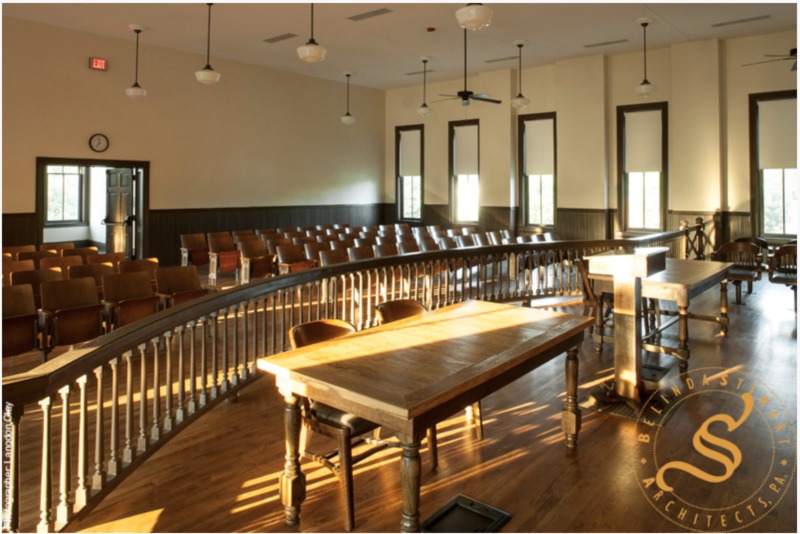
    <summary type="html"><![CDATA[<p><strong><em>For nearly 50 years, the murder of Emmett Till was not commemorated in Tallahatchie County. Even the courthouse itself hid the story. Only recently has the second district Tallahatchie County Courthouse been used to tell Till's story.</em></strong></p><img src="https://tillapp.emmett-till.org/files/fullsize/721ee5cdef8479da0d84c5dc3ca54680.jpg" alt="Courthouse interior after the Belinda Stewart Renovation " /><br/><p>On September 19, 1955, at 9:25 am, the trial of J. W. Milam and Roy Bryant for the murder of Emmett Till opened in this courthouse. It was a sensational, five-day trial. For the first time in history, the Northern press descended on a Mississippi trial. To this day, locals recall the spectacle that was the Till trial: the microphones, the cameras, the reporters, and the stifling heat of the second-floor courtroom. With approximately 400 people crowded into the small space (sitting in aisles and hanging out of windows), temperatures inside exceeded ninety degrees. For all these reasons, celebrated journalist David Halberstam, who attended the trial as a reporter for a West Point, MS newspaper, called the trial “the first great media event of the civil rights movement.”</p><p>The trial lasted a scant five days. It would have been even shorter, had the black press not managed to secure an extended recess on the second day of the trial. Baltimore Afro-American reporter James Hicks, Medgar Evers, and Mound Bayou’s Dr. T. R. M. Howard rounded up five witnesses that claimed (correctly) that Till was beaten (and possibly killed) by J. W. Milam and others in a barn outside of Drew, MS. Drew was 20 miles southwest in Sunflower County, and, if the witnesses were correct, the trial would have to be moved to the neighboring county. Judge Curtis Swango called a recess to investigate the possibility. In the end, the witnesses were not believed and the trial was not moved.</p><p>On Friday, September 23, the all-white jury took only 67 minutes to deliberate before returning a verdict of not guilty. It was widely reported that the only reason it took them as long as it did was that they drank some Cokes in order to make it appear as if they were struggling with the decision.</p><p>The Cokes notwithstanding, the jury did not struggle to reach a verdict. They believed (or at least they said they did) the testimony of Sheriff H. C. Strider, Harry D. Malone, and Dr. L. B. Otken—all of whom argued that the body could not be positively identified as Emmett Till. The body was so badly decomposed by the time it was retrieved from the Tallahatchie River, these men argued, that the race of the body could not be determined. And, if the race of the body could not be determined, there was no way to verify that the body was Emmett Till. Thus were the murderers acquitted.</p><p>The testimonies of these men are deeply suspect. Malone never saw the body (although he claimed he did), and Strider changed his mind in dramatic fashion. A month earlier, when the Sheriff pulled Till’s body from the water, he marked the death certificate “colored” and sent the body to Chester Miller’s Century Burial Funeral Home—the black funeral home in Greenwood. His later suggestion, under oath, that the body was so decomposed that its race could not be determined was nothing more than a lie to secure an acquittal.</p><p>On July 1, 1972, the Tallahatchie County Board of Supervisors announced that the Courthouse in Sumner would be renovated by Yazoo City architect Jack DeCell. In the name of modernization, and at a cost of $235,000, the chairs were replaced with pews, the sash windows were replaced with solid glass, interior walls were added to the courtroom to shrink the space by over 800 square feet, and the courtroom was painted purple. The renovations were so dramatic that some locals believe the DeCell renovation was intended to bury all memory of Till’s murder. Those who believe this are quick to note that it was during the DeCell renovation that the cotton gin fan that once anchored Till’s body was lost.</p><p>In 1990, the Sumner courthouse was listed on the state register of historic places. Curiously, the historic places nomination makes no mention of the Till murder. The courthouse is nominated only for architectural reasons. The courthouse, the state claimed, is one of a very few remaining examples of Richardsonian Romanesque architecture. For some, this focus on architecture and the complete silence on the famous trial seemed like yet another attempt to forget Till’s murder.</p><p>Beginning in 2005, the Emmett Till Memorial Commission set out to undo the work of DeCell and the historical nomination. By renovating the courthouse to its 1955 condition, the Commission shifted the primary narrative of the courthouse. It was no longer about architecture; it was about race, memory, and justice. In this spirit, the Commission organized a formal apology to the Till family from the county in 2007.</p><p>In 2015, the space reopened, both as an operating courthouse and a living memorial to the Till murder. The renovation was done by Belinda Stewart Architects of Eupora.</p><p><em><strong><a href="https://tillapp.emmett-till.org/items/show/9">For more (including 11 images&#32;&amp;&#32;1 video) view the original article</a></strong></em></p>]]></summary>
    <published>2019-07-17T10:34:54+00:00</published>
    <updated>2026-04-17T19:39:38+00:00</updated>
    <link rel="alternate" type="text/html" href="https://tillapp.emmett-till.org/items/show/9"/>
    <id>https://tillapp.emmett-till.org/items/show/9</id>
    <author>
      <name>Dave Tell </name>
    </author>
  </entry>
  <entry>
    <title type="html"><![CDATA[Tutwiler Funeral Home: The Body&#039;s Last Stop in Mississippi<br />
]]></title>
    <summary type="html"><![CDATA[<p><strong><em>Operated by town Mayor Chick Nelson, the Tutwiler Funeral Home played an essential role in the acquittal of the murderers and in the dissemination of a once-common myth that Till had not been killed.</em></strong></p><img src="https://tillapp.emmett-till.org/files/fullsize/4abfb6bfd28e4acb44c362f6a2fefb80.jpg" alt="Interior of Tutwiler Funeral Home " /><br/><p>During the Till trial of September 1955, embalmer Harry D. Malone was an important witness for the defense. He testified that the body was in such poor condition that it must have been in the Tallahatchie River for at least ten days. This, of course, meant that the body could not be Emmett Till and the defendants could not be guilty. Along with Sheriff Strider’s testimony, Malone’s narrative was a key factor in the jury’s official rationale for acquitting J. W. Milam and Roy Bryant.</p><p>However, in his closing remarks to the jury, prosecutor Robert Smith argued that Malone did not personally embalm the body and therefore was not in a position to judge either its condition or the amount of time it was in the river. Although Smith did not suggest an alternative, many believe that Till’s body was actually prepared by Malone’s black assistant Woodrow Jackson.</p><p>If it was Woodrow Jackson who embalmed the body in Tutwiler (and most historians now agree it was), this means that a key witness for the defense was lying on the stand. The acquittal was built on a false narrative.</p><p>Woodrow Jackson is an elusive figure in the history of the Till case. Not until the twenty-first century did he begin to appear in accounts of the murder. The reason he so rarely appeared in history is obvious: his presence in the Till story would undermine the supposed innocence of the murderers, whose acquittal required Malone as the primary embalmer instead of Jackson.</p><p>To right this wrong, the Emmett Till Memorial Commission has invested in the memory of Woodrow Jackson. When he passed in 2007, they issued a formal recognition of his role embalming the body. And when they commemorated the Tutwiler Funeral Home in 2008, their sign betrayed no hint of controversy: “On August 31, 1955, Woodrow Jackson prepared Emmett Till’s body here at the Tutwiler Funeral Home.”</p><p><em><strong><a href="https://tillapp.emmett-till.org/items/show/8">For more (including 5 images) view the original article</a></strong></em></p>]]></summary>
    <published>2019-07-16T20:33:15+00:00</published>
    <updated>2026-04-17T19:39:38+00:00</updated>
    <link rel="alternate" type="text/html" href="https://tillapp.emmett-till.org/items/show/8"/>
    <id>https://tillapp.emmett-till.org/items/show/8</id>
    <author>
      <name>Dave Tell</name>
    </author>
  </entry>
  <entry>
    <title type="html"><![CDATA[Charleston Jail : How Two Murderers Walked Free]]></title>
    <summary type="html"><![CDATA[<p><strong><em>The Tallahatchie County Jail in Charleston, MS may or may not have been involved in the murder of Emmett Till and the cover-up that followed.</em></strong></p><img src="https://tillapp.emmett-till.org/files/fullsize/9b7759070385381e0deb5a7f17ffa763.jpg" alt="Tallahatchie County Jail, Charleston MS, 2015" /><br/><p>According to the century’s most influential account of the murder, the so-called “confession” published in <em>LOOK Magazine</em> in January 1956, the Charleston jail played no role in the Till story. If we believe the <em>LOOK</em> account, then the murder was carried out by J. W. Milam and Roy Bryant, both of whom were tried, and acquitted, in a court of law. It may be a sad story of racism taking the life of an innocent boy, but at least each of the perpetrators stood trial--or so <em>LOOK</em> would have you believe.</p><p>In 1955, however, there was no such consensus. The black press believed that far more people were directly involved in the murder and, in 2006, the FBI confirmed that hunch. As the number of perpetrators grows, so too does the likelihood that the Tallahatchie County Jail in Charleston played a key role in restricting the number of men brought to trial.</p><p>The story began when Baltimore Afro-American reporter James Hicks went undercover at King’s Place—a Glendora, MS juke joint—where he was informed that two of Milam’s black employees were forced to be involved in Till’s kidnap and murder. The employees were Levi “Too Tight” Collins and Henry Lee Loggins. Because Loggins and Collins were eyewitnesses to the murder they held the potential, if they could be found and convinced to testify, to fundamentally alter the legal proceedings. They could have testified, for example, that Till was tortured on the Milam Plantation in Drew, MS by a party of at least four white men. They also, of course, could testify to the simple fact that Till was murdered (a fact the jury chose not to believe).</p><p>Loggins and Collins, however, could not be found. According to Hicks’s source, the men had been booked in this jail, in Charleston, 28 miles away from the trial, to preclude the possibility that they might be found and might testify. Concerns about the safety of the potential witnesses kept Hicks from pursuing this lead immediately. By the time prosecutors Gerald Chatham and Robert Smith checked the jail, there was no sign of Collins or Loggins.</p><p>Although neither Loggins nor Collins could be found to testify in the trial, the story Hicks learned at King’s Place—and which implicated this jail—was corroborated in 1955 by the work of Dr. T. R. M. Howard in Mound Bayou, in 1963 by historian Steve Whitaker, and in 2006 by the FBI. The more we learn about the Till case, the more likely it seems that Loggins and Collins were involved in the murder and detained here, lest they bear witness at the trial.</p><p><em><strong><a href="https://tillapp.emmett-till.org/items/show/7">For more (including 2 images) view the original article</a></strong></em></p>]]></summary>
    <published>2019-07-16T20:19:28+00:00</published>
    <updated>2026-04-17T19:39:38+00:00</updated>
    <link rel="alternate" type="text/html" href="https://tillapp.emmett-till.org/items/show/7"/>
    <id>https://tillapp.emmett-till.org/items/show/7</id>
    <author>
      <name>Dave Tell</name>
    </author>
  </entry>
  <entry>
    <title type="html"><![CDATA[Graball Landing: Locals believe that Till was pulled from the river at this site ]]></title>
    <summary type="html"><![CDATA[<p><strong><em>This oft-vandalized site has become the center of a national conversation on race and vandalism. Signs from this spot have been stolen, replaced, shot, replaced again, and shot again. One of the signs ended up at the Smithsonian's National Museum of American History; a second sign is now touring the country as part of a traveling exhibit created by the Children's Museum of Indianapolis. </em></strong></p><img src="https://tillapp.emmett-till.org/files/fullsize/7255707ed6a04c2be2e9b7fe18c462bc.jpg" alt="The bullet proof sign at Graball Landing, just after its October 2019 dedication" /><br/><p>Graball Landing sits at the confluence of the Tallahatchie River and the Black Bayou. Many locals believe that it is the site where Till’s body was recovered from the Tallahatchie River. Since April 2008, the site has become the focus of national controversy as the Emmett Till Memorial Commission’s (ETMC) attempts to commemorate the landing have been met by repeated vandalism.</p><p>It is difficult to say with certainty where the body was recovered. In 1955, there was widespread agreement that the body was found near Pecan Point, a few miles downstream from this spot. In 2006, the FBI concluded that Till’s body was discovered several miles downstream at a spot where the Tallahatchie River briefly dips into Leflore County. After being pulled into a boat, the body was then brought to Fish Lake Landing (very near Pecan Point) where it was finally removed from the water.</p><p>Regardless of whether or not Graball Landing is the correct site, the local belief in the validity of this site has made the landing a nationally recognized (and nationally contested) memory site.</p><p>The ETMC first commemorated this site in 2008, erecting a sign that claimed, unequivocally, “this is the site where Till’s body was removed from the river.” Within six months, the sign was stolen and thrown into the river. This was the first instance of what would become a repeated problem: vandalism. A second sign quickly replaced the first, but it was quickly filled with bullet holes.</p><p>In 2016, NYU student Kevin Wilson happened on the shot-up sign. He posted it to Facebook and, within days, the vandalism was covered by every major media outlet in the country.</p><p>The media coverage generated intense moral outrage and a widespread demand to replace the sign. When the big-hearted Brooklyn sign manufacturer Lite Brite Neon volunteered to fabricate, ship, and install a new marker free of charge, the Commission quickly cut down the old sign to make room for the new one.</p><p>But without waiting for the Lite Brite sign to be fabricated, the ETMC bought a third a sign, identical to the first two, and dedicated it on June 21, 2018. It lasted only 35 days before it, too, was shot. And then, sometime between July 27, 2018 and September 10, 2018, three Ole Miss fraternity brothers posed in front of it with guns, trophy style. Shortly after news of the fraternity brother's publicity stunt, the ETMC took down the third sign.</p><p>The fourth sign was dedicated on October 19, 2019.</p><p>The fourth sign was crafted by Lite Brite Neon. As was widely reported in the national press, it is bullet proof. It is made from 1/2" AR500 steel and covered with a 3/4" replaceable polycarbonate plate. Weighing in at nearly 500 lbs., the sign is designed to absorb a rifle round.</p><p>Unlike the first three signs, the language on bullet-proof sign addresses the history of vandalism directly. Believing that the bullet holes are part of Till’s story too, the new sign is designed to register the history of vandalism even as it resists future attempts to desecrate the site.</p><p>The ETMC never imagined that a bullet-proof sign would solve fundamental issues of racism. And it didn't. On November 2, 2019, white nationalists gathered at the site to film a promotional video.</p><p>The history of vandalism and activism centered on this site led ETMC founder Jerome Little to observe that Graball Landing is both a beacon of racial progress and a trenchant reminder of the progress yet to be made.</p><p><em><strong><a href="https://tillapp.emmett-till.org/items/show/6">For more (including 12 images&#32;&amp;&#32;1 video) view the original article</a></strong></em></p>]]></summary>
    <published>2019-07-16T15:15:50+00:00</published>
    <updated>2026-08-27T17:07:02+00:00</updated>
    <link rel="alternate" type="text/html" href="https://tillapp.emmett-till.org/items/show/6"/>
    <id>https://tillapp.emmett-till.org/items/show/6</id>
    <author>
      <name>Dave Tell </name>
    </author>
  </entry>
  <entry>
    <title type="html"><![CDATA[Emmett Till Historic Intrepid Center: The ETHIC Musuem]]></title>
    <summary type="html"><![CDATA[<p><strong><em>Originally the Glendora Cotton Gin, Glendora Mayor Johnny B. Thomas transformed this building into one of the earliest Till museums in the world: the Emmett Till Historic Intrepid Center (the ETHIC museum). </em></strong></p><img src="https://tillapp.emmett-till.org/files/fullsize/a6376ce6441353ec294525543f2ae5cc.jpg" alt="Emmett Till Historic Intrepid Center, Glendora, MS. ~2015. " /><br/><p>The story told in the ETHIC museum is unique on two counts.
First, while virtually every 20th-century history of Till’s murder suggests that the murderers dropped the body in the Tallahatchie River, the commemorative work in Glendora suggests that Till was dropped into a tributary known as the Black Bayou from a bridge on the south side of Glendora. According to this account, the bayou then carried Till’s body for 3 miles to the Tallahatchie River, where it was recovered near Graball Landing.
Second, while no historian has been able to claim with certainty where the murderers obtained the fan they used to weigh down Till’s corpse, the Glendora museum claims that the fan was stolen from this site, the Glendora Cotton Gin, presumably by Elmer Kimbrell, a gin employee and the next-door neighbor of confessed murderer J.W. Milam.
While these variations on the finer points of Till’s story are contested, to Glendora residents they are matters so weighty that it seems as if the very future of the town hinges on where Till’s body was dropped in the water and what fan weighed it down.
In 2010, the Mississippi Development Authority sent a team of economic development experts to Glendora. Their charge was to devise a plan to rescue the town from poverty — a tall order. Glendora is marked by breathtaking poverty with a median household income 70% below the state average. 
The team struggled to find solutions. Aside from the unrealistic suggestion that the town turn the snake-infested land along the bayou into “riverfront property,” their only other proposal was that Glendora capitalize on its connection to the Till murder. More commemoration, they said, would bring tourists; tourism would beget economic development. The viability of this suggestion, of course, turned on a version of Till’s story that maximized the relevance of Glendora. 
None of this was news to Glendora Mayor Johnny B. Thomas. Since at least 2005, he had been promoting a Glendora-centric narrative of the murder in which Till’s body was dropped in the Black Bayou tied with a fan from the local gin.
While these are both plausible claims, Thomas’s efforts have been undermined by a consistent antagonist: the Mississippi Department of Archives and History (MDAH).
The MDAH has invested more funds into Till’s commemoration than any other organization. It restored the Tallahatchie County Courthouse, the site of the Till trial, and even invested more than $200,000 in the controversial restoration of Ben Roy’s Service Station in Money.
The agency, however, is not convinced that Till’s body was dropped from the Black Bayou Bridge. Nor does the organization believe that the fan was stolen from the local gin. It has thus rejected every grant application the town has ever submitted. Locals are quick to point out that the MDAH funded the white memorial in Money (despite its implausability) but denied the all-black town of Glendora (despite its plausability). </p><p>Mayor Thomas (and the entire town of Glendora) was in a bind. They had one state agency (the MDA) telling them to invest in Till commemoration and a second state agency (the MDAH) blocking their every attempt to do so. </p><p>While some people might give up, Mayor Thomas got creative. </p><p>By leveraging the poverty of the town, he has obtained grant money from other sources. The work began on Sept. 27, 2005. On that day, the U.S. Department of Agriculture awarded a Community Connect Broadband Grant to Glendora. Funded at $325,405, the grant was intended to bring broadband connectivity to Glendora. Thomas used the grant to both provide broadband <em>and</em> build the first version of the ETHIC museum. In April 2010, he received an IMLS grant to professionalize the museum.
The USDA grant program was intended to alleviate poverty. The Mayor’s ingenuity and creativity was able to bend those dollars to create a much-needed museum. </p><p>And yet, questions remain unanswered. Was Emmett Till actually dropped from the Black Bayou Bridge? Was the fan stolen from a local gin? Was Elmer Kimbrell involved?
Perhaps. But it is impossible to separate the truthfulness of these claims from the poverty of the townspeople. Thomas has leveraged the town’s poverty to build a museum, and the museum, in turn, supports Glendora’s plausible-but-unverifiable theories of the murder.
Had Glendora been wealthy, Thomas would have had no claim on federal dollars, and there would be no museum. But Glendora is not wealthy. And for this reason, stories about Kimbell, the gin, and the bridge continue to circulate, supported by nothing but the poverty of the town.</p><p>In 2008, this site was one of four Glendora sites added to the Tallahatchie Civil Rights Driving Tour created by the Emmett Till Memorial Commission. </p><p><em><strong><a href="https://tillapp.emmett-till.org/items/show/5">For more (including 8 images) view the original article</a></strong></em></p>]]></summary>
    <published>2019-07-16T14:16:55+00:00</published>
    <updated>2026-04-17T19:39:38+00:00</updated>
    <link rel="alternate" type="text/html" href="https://tillapp.emmett-till.org/items/show/5"/>
    <id>https://tillapp.emmett-till.org/items/show/5</id>
    <author>
      <name>Dave Tell</name>
    </author>
  </entry>
  <entry>
    <title type="html"><![CDATA[Seed Barn, Milam Plantation: The Long-Forgotten Murder Site]]></title>
    <summary type="html"><![CDATA[<p><strong><em>Although Till was likely killed in this barn, it remains one of the few sites in the Delta without any commemoration. Until now! </em></strong></p><img src="https://tillapp.emmett-till.org/files/fullsize/cd2ea52420e11f92081e9a834d7ab415.jpg" alt="Milam Seed Barn" /><br/><p>According to the so-called “confession” penned by journalist William Bradford Huie in the January 24, 1956 issue of <em>LOOK Magazine</em>, Emmett Till was beaten in a shed behind J.W. Milam’s house in Glendora, taken to a steep bank on River Road, shot in the head, and dumped into the Tallahatchie River weighted down by a 75-pound blast wheel from a cotton gin.  For decades, Huie’s account functioned as the definitive word on what happened to Emmett Till in his final hours.
We now know that Huie’s account was wrong. Till was tortured and killed in a seed barn on what was once the Milam Plantation.
Huie’s story leaves out the explosive eyewitness testimony of 18-year-old Willie Reed, a black plantation worker walking to a local store early on Sunday morning, August 28.  Reed saw Milam’s 1955 Chevrolet pickup arrive on the Plantation with Emmett Till and two guards in its bed and four white men in its cab. Reed then heard screams coming from the plantation’s small seed barn, which was managed by Milam’s brother and Bryant’s half-brother, Leslie.
There is a reason Huie eliminated Reed’s testimony from his story. <em>LOOK</em> refused to print the story without signed consent and release forms from every named participant in the murder. Unsurprisingly, Huie could only obtain such forms from the two men (Roy Bryant and J. W. Milam) who had already been tried and were therefore no longer in legal jeopardy. Leslie Milam had not been tried, he did not sign a release form, and he could not be implicated in Huie’s story. So Huie moved the murder to an abandoned spot of riverbank in Tallahatchie County, thus eliminating the roles of Willie Reed (witness) and Leslie Milam (accomplice). Although it is wrong, Huie’s story has been so influential that <em>every single</em> map published on the Till murder between the publication of <em>LOOK’s</em> article in January 1956 and 2005 left the Milam Plantation off the map entirely.
Remarkably, among the many Till commemorative sites and signs dotting the Delta landscape, this terribly important place continues to exist in a memory void. There is not a single plaque, marker, or memorial at the still-standing seed barn. </p><p>But things are beginning to change. Led by civil rights legend Gloria Dickerson, the town of Drew is beginning the process of commemorating the site. On August 28, 2022--the 67th anniversary of the murder--hundreds of townspeople attended the first ever commemorative ceremony at the barn. </p><p><em><strong><a href="https://tillapp.emmett-till.org/items/show/4">For more (including 3 images&#32;&amp;&#32;1 video) view the original article</a></strong></em></p>]]></summary>
    <published>2019-07-16T11:11:11+00:00</published>
    <updated>2026-04-17T19:39:38+00:00</updated>
    <link rel="alternate" type="text/html" href="https://tillapp.emmett-till.org/items/show/4"/>
    <id>https://tillapp.emmett-till.org/items/show/4</id>
    <author>
      <name>Dave Tell</name>
    </author>
  </entry>
  <entry>
    <title type="html"><![CDATA[East Money Church of God in Christ: The Story of Till&#039;s Murder Nearly Died Here]]></title>
    <summary type="html"><![CDATA[<p><strong><em>Had Till been buried here, we wouldn't know his name.</em></strong></p><img src="https://tillapp.emmett-till.org/files/fullsize/09fc294ac62421bed5387fb08d7c8043.jpg" alt="Ruins, East Money Church of God In Christ, 2017" /><br/><p>After Till’s body was found, local law enforcement was anxious to bury the body and, they hoped, the story. Within hours of the body’s retrieval, a grave was dug at the East Money Church of God in Christ. Till’s great uncle Crosby Smith interrupted the digging. He arrived with a deputy sheriff and announced that Till’s mother, Mamie Till, insisted that her son’s body be returned home to Chicago. 
When the body arrived in Chicago the following day, September 2, Mamie Till demanded that funeral director A. A. Rayner open the casket; she wanted to see her son. Rayner eventually opened the casket and Mamie Till began the torturous process of identifying her only child.  So badly disfigured was the body that she had to rely on Till’s hair, teeth, and ears to make a positive identification. What she did next changed the course of history: she invited black photographer David Jackson to take pictures of the corpse—notably the boy’s mutilated face—and allowed several black newspapers and <em>Jet Magazine</em> to print them.  As she would say for the rest of her life, “Let the world see what I’ve seen. . . . The whole nation had to bear witness to this.”   
Emmett Till had recently turned 14 years old when he became a household name in 1955. A generation of young black boys and girls saw the grisly photographs in the pages of <em>Jet</em> and elsewhere.  This was the generation who would change Mississippi forever through organizations such as the Student Nonviolent Coordinating Committee and the Congress of Racial Equality; activists would often trace the origins of their activism to seeing the corpse of Emmett Till.  Had his body been quietly interred in this humble plot off of Darfield Road, the history of race in America would have looked very different.</p><p><em><strong><a href="https://tillapp.emmett-till.org/items/show/3">For more (including 2 images&#32;&amp;&#32;1 video) view the original article</a></strong></em></p>]]></summary>
    <published>2019-07-15T21:48:54+00:00</published>
    <updated>2026-04-17T19:39:38+00:00</updated>
    <link rel="alternate" type="text/html" href="https://tillapp.emmett-till.org/items/show/3"/>
    <id>https://tillapp.emmett-till.org/items/show/3</id>
    <author>
      <name>Davis Houck</name>
    </author>
  </entry>
  <entry>
    <title type="html"><![CDATA[Black Bayou Bridge: Till&#039;s body may have been dropped in the water from this bridge.]]></title>
    <summary type="html"><![CDATA[<p><strong><em>Many people believe that this bridge may have been the spot that the body of Emmett Till was dropped into the water. Approximately two miles east of this spot, the Bayou spills into the Tallahatchie River. At the confluence of the two rivers is a site called Graball Landing; it is marked by an Emmett Till Memorial Commission sign as the site where Till’s body may have been recovered from the river. </em></strong></p><img src="https://tillapp.emmett-till.org/files/fullsize/157b85a15899602d261c7f26c1f702a5.jpg" alt="Black Bayou Bridge" /><br/><p>The strongest argument in favor of the theory that Till was thrown off this bridge and recovered at Graball Landing is its intuitiveness. This site is immediately adjacent to both J. W. Milam’s home (where Till’s clothes were burned) and the Glendora Cotton Gin (where they could have easily secured the fan with the help of Milam’s neighbor Elmer Kimbell, who worked at the gin). Because the murderers were in a race with daybreak to dispose of the body as quickly as possible, they certainly would have appreciated the proximity of this bridge. Heightening the credibility of this theory is the fact that this road was closed permanently sometime in 1955. 
Beyond the intuitive convenience of the theory, the Black Bayou Bridge theory has a strong advocate in Glendora Mayor Johnny B. Thomas. Thomas has used the Emmett Till Historic Intrepid Center (a Till museum just up the road) to advocate for this theory for years. </p><p>Thomas has a vested interest in this site. In 2010, the Mississippi Development Authority advised him that Emmett Till tourism represented the best chance at economic development for the town. The more the story of Till's murder centers on Glendora, the more tourists will have reason to come, and the more economic development will follow. </p><p>But quite apart from matters of tourism, Thomas does have an interesting story. He claims that his father was Henry Lee Loggins—Milam’s “right hand” man who was widely rumored to be personally involved in the murder.
According to African American journalist James L. Hicks, Loggins and Levi “Too Tight” Collins (both black men) were forced by J. W. Milam to participate in the torture and murder of Emmett Till before being jailed in Charleston on trumped up charges to keep them away from the investigation. Defense attorney J. J. Breland later confirmed that Loggins and Collins were held on false charges to prevent them from testifying. 
Although Loggins publicly denied all involvement his entire life (most publicly on <em>60 Minutes</em>), there are rumors that he made a deathbed confession to his son. If true, it means that Thomas’s claim that the body was thrown over this bridge might be based on Loggin's personal involvement.</p><p><em><strong><a href="https://tillapp.emmett-till.org/items/show/2">For more (including 5 images) view the original article</a></strong></em></p>]]></summary>
    <published>2019-07-15T21:15:51+00:00</published>
    <updated>2026-04-17T19:39:38+00:00</updated>
    <link rel="alternate" type="text/html" href="https://tillapp.emmett-till.org/items/show/2"/>
    <id>https://tillapp.emmett-till.org/items/show/2</id>
    <author>
      <name>Dave Tell </name>
    </author>
  </entry>
  <entry>
    <title type="html"><![CDATA[Bryant&#039;s Grocery &amp; Meat Market: The Long-Ignored Site Where the Civil Rights Movement Started ]]></title>
    <summary type="html"><![CDATA[<p><strong><em>It was at Bryant's Grocery & Meat Market that Emmett Till whistled at Carolyn Bryant and jump-started the American Civil Rights Movement. But the building has been allowed to fall into ruin. Worse still, civil rights money intended to restore civil rights sites has been intentionally directed away from the building.</em></strong></p><img src="https://tillapp.emmett-till.org/files/fullsize/e249b45ffe3a44b723b372624bda8af4.jpg" alt="Bryant&#039;s Grocery and Meat Market " /><br/><p>On August 24, 1955, Emmett Till arrived at Bryant’s Grocery around 7:30 pm along with several cousins and friends. The primary attraction was the checkers game on the front porch. With his companions thus engaged, Till followed his cousin Wheeler Parker into the store. </p><p>When Wheeler came out of the store, Simeon Wright went in. Twelve years old, Wright grew up in the Mississippi Delta, knew the rules of the Jim Crow South, and didn't want to leave his Chicago cousin alone with white shopkeeper Carolyn Bryant. 
When Simeon entered the store, he saw nothing inappropriate. Contrary to the story later told in court by Carolyn Bryant, Till did not grab her or put his arms around her. He did not proposition her. He did not ask her for a date or call her "baby." He simply paid for his items and left the store. </p><p>Shortly after the cousins left the store, Carolyn Bryant came out too, heading for her car. That is when it happened. </p><p>Emmett whistled at Carolyn Bryant. As Simeon Wright remembers it, "It was a loud wolf whistle, a big-city 'whee wheeeee.'"  </p><p>Although historians have debated whether or not Till actually whistled, those who witnessed the event have always insisted that he did. Critically, Till's cousins Simeon Wright and Wheeler Parker (both eyewittnesses) insist that Till whistled. </p><p>The whistle violated the norms of the Jim Crow South, and Wright and Parker both knew it. It had broken an "unwritten law" that governed the interactions of black men and white women. Worried, they hurried Till away from the store as fast as possible. </p><p>The unwritten laws of the Jim Crow South were enforced through lynch mobs and vigilante violence. In this case, Carolyn’s husband Roy, his half-brother J. W. Milam, and an array of accomplices kidnapped Till, tortured him, shot him, attached his body to a cotton-gin fan with a length of barbed wire, and dropped his body in a river. </p><p>It is entirely fitting that, in 2020, when the US House of Representatives finally passed a federal antilynching bill, it was named the Emmett Till Antilynching Act. </p><p>For nothing more than a whistle, Till experienced the full fury of the Southern lynch mob. His innocence was answered by unimaginable violence. Indeed, the violence was so intense that it suggests a desperate effort to uphold the fading norms of white supremacy.</p><p>The effort did not work. Virtually every historian agrees that the Till murder jump-started the civil rights movement.  </p><p>While the brutal murder may have galvanized the movement, the grocery store has been allowed to fall into ruin. After the acquittal, the black sharecroppers that once kept Bryant’s Grocery in business refused their patronage, and the store was put up for sale less than a month after the trial. For the next three decades, the building was maintained as a country grocery by different owners—first as Wolfe’s and then as Young’s Grocery and Market. </p><p>Since the early 1980s, the site of Bryant’s Grocery & Meat Market has been owned by the Tribble family. Ray Tribble was a juror in the 1955 Till trial, and his children now own the site. In 2011, the Tribble family led the charge to renovate the adjacent gas station, Ben Roy’s Service Station. Although Ben Roy’s has no civil rights history, the family was able to leverage its proximity to Bryant’s Grocery to obtain money set aside for civil rights restoration. Unfortunately, the restored Ben Roy’s makes no mention of Till, the civil rights movement, or Bryant’s Grocery. </p><p>Several parties have offered to buy the property from the Tribbles in the interest of restoring it as a memory site. As of 2019, the Tribbles have refused to sell the property for less than $4 million. While the world sees Bryant’s Grocery as the origin of the civil rights movement, the Tribbles apparently see it as potentially valuable commercial property.</p><p><em><strong><a href="https://tillapp.emmett-till.org/items/show/1">For more (including 10 images&#32;&amp;&#32;1 video) view the original article</a></strong></em></p>]]></summary>
    <published>2019-07-15T20:10:38+00:00</published>
    <updated>2026-04-17T19:39:38+00:00</updated>
    <link rel="alternate" type="text/html" href="https://tillapp.emmett-till.org/items/show/1"/>
    <id>https://tillapp.emmett-till.org/items/show/1</id>
    <author>
      <name>Dave Tell</name>
    </author>
  </entry>
</feed>