<?xml version="1.0" encoding="UTF-8"?>
<feed xmlns="http://www.w3.org/2005/Atom">
  <title type="text">Emmett Till Memory Project</title>
  <updated>2026-04-17T19:39:38+00:00</updated>
  <generator uri="http://framework.zend.com" version="1.12.20">Zend_Feed_Writer</generator>
  <link rel="alternate" type="text/html" href="https://tillapp.emmett-till.org/"/>
  <link rel="self" type="application/atom+xml" href="https://tillapp.emmett-till.org/items/browse?output=rss2"/>
  <id>https://tillapp.emmett-till.org/</id>
  <author>
    <name>Emmett Till Memory Project</name>
    <uri>https://tillapp.emmett-till.org</uri>
  </author>
  <link rel="hub" href="https://pubsubhubbub.appspot.com/"/>
  <entry>
    <title type="html"><![CDATA[Mound Bayou: The activists and journalists who stayed in Mound Bayou were the only ones telling the true story of Till&#039;s murder. No one believed them]]></title>
    <summary type="html"><![CDATA[<img src="https://tillapp.emmett-till.org/files/fullsize/4e1030a936ce96155d27847573cb40c7.jpg" alt="T. R. M. Howard&#039;s Taborian Hospital, 2015" /><br/><p>Although Mound Bayou is 42 miles away from Sumner, it played an essential role in the Emmett Till trial. The town provided protection for witnesses, a home base for the black press, and a refuge for Till’s mother Mamie Till-Bradley. Without Mound Bayou, we might still not know what happened to Emmett Till.</p><p>Mound Bayou was home to the legendary Mississippi activist Dr. Theodore Roosevelt Mason (T.R.M.) Howard. Although he is generally remembered for his 1951 founding of the Regional Council of Negro Leadership, Howard’s civil rights credentials were vast. He organized a non-violent movement in the Mississippi Delta four years before the Montgomery Bus Boycott (and three years before Emmett Till’s murder), he organized annual civil rights rallies, and he stoked Medgar Evers’ nascent activism by hiring him for his Magnolia Life Insurance Company. </p><p>His charismatic style meant that threats on his life were common. In the years before Till was murdered, Howard already had a $1,000 price tag on his life. He traveled with armed bodyguards, and his home featured twenty-four-hour-a-day armed protection. The sheer security of the Howard home explains why so many African Americans stayed with him when they came to Mississippi for the Till trial. Mound Bayou may have been 42 miles away from Sumner and the trial, but it offered unsurpassed safety. This is why Till’s mother Mamie Till-Bradley, Michigan Congressman Charles C. Diggs, and other African Americans used the Howard home as their base camp.</p><p>Beginning on the evening of Sunday, September 18, 1955, Howard’s home became far more than a base camp. Around midnight on the 18th, a young black plantation worker named Frank Young arrived at the Howard home claiming that he had direct evidence linking J. W. Milam, Roy Bryant, and four others to the murder. He also broke the then-shocking news that Till had been killed in Sunflower County. This was timely information. A widely-recognized liability of the prosecution’s case was their inability to locate the site of the murder. Just six days earlier, defense lawyer J. J. Breland had predicted an acquittal based, in part, on the inability of the prosecution to determine the murder site.</p><p>Young put these anxieties to rest. He told Howard that, at approximately 6 am on August 28, Till had been conveyed via a pickup truck crowded with four white people in the front and three African Americans in the back (including Till) to the seed barn on the Milam Plantation. Operated by J. W. Milam’s brother Leslie, the Milam Plantation is located about three miles west of Drew in Sunflower County. Young then told Howard that witnesses heard desperate screams emanating from the same barn; that they saw J. W. Milam emerge from the barn for a drink of water; that the screams gradually faded; and that a body was taken from the barn, covered with a tarpaulin, and placed in the back of a truck. He further assured Howard that this entire story could be vouchsafed by five Black witnesses: himself, Willie Reed, Add Reed, Walter Billingsley, and Amanda Bradley.</p><p>It is difficult to over-estimate the significance of Young’s account or its potential to challenge what people thought they knew about Till’s kidnapping and murder. It directly implicated far more people than J. W. Milam and Roy Bryant—who were the only defendants that week. It also implicated Leslie Milam, a fourth unknown white man, and two unknown Black men who were in the back of the truck with Till. </p><p>If Howard had any doubts about the veracity of Young’s story, he would have been reassured when, on the same night, A<em>fro-American</em> reporter James Hicks showed up directly from his experience at King’s Place in Glendora. Hicks’s story about Levi “Too Tight” Collins and Henry Lee Loggins fit perfectly with Frank Young’s tale. With the two stories combined, Howard now knew the identities of the two unknown Black men in the back of the truck.</p><p>The next evening (after the first day of the trial was complete), Howard called a strategy meeting at his home in Mound Bayou. Present at the meeting were NAACP officers Medgar Evers and Ruby Hurley and three influential members of the Black press: James Hicks, L. Alex Wilson (<em>Tri-State Defender</em>), and Simeon Booker (<em>Jet</em>). Although Hurley, Booker, and Hicks wanted to go public with the story immediately, Howard prevailed upon them to hold the story until the safety of the five witnesses could be assured. They agreed to contact the state’s lawyers through a trusted member of the white press, the <em>Memphis Press-Scimitar</em>’s Clark Porteous.</p><p>Porteous came immediately and met the group at Howard’s Magnolia Mutual Insurance Company. They made a plan: Porteous would invite District Attorney Gerald Chatham and his assistant Robert Smith to a second meeting at Howard’s home at 8 pm the following day. Medgar Evers and his NAACP colleagues would don cotton-picking clothes and go undercover as sharecroppers to bring the witnesses to the meeting. Once everyone was assembled, Howard would tell Young’s story, produce the five witnesses, and prevail upon the lawyers to stop the trial and move it to Sunflower County.</p><p>The meeting never happened. After Porteous conveyed the news to Chatham and Smith during Tuesday’s lunch recess, officials from Sunflower County headed to the Milam Plantation and inadvertently scared the witnesses. When the witnesses failed to show up for the meeting, the Black press and white legal establishment joined forces in what Simeon Booker later called “Mississippi’s first interracial manhunt.” By 3 am on Tuesday, September 20, the team of Hicks, Booker, Porteous, Featherstone, and Leflore County Sheriff George Smith had made contact with each of the five witnesses. Howard assured the witnesses they would be kept safe (Willie Reed moved in with Howard that night) and promised each of them jobs in Chicago in exchange for their testimony.</p><p>On Thursday, September 22, 1955, Willie Reed left the home of T. R. M. Howard and proceeded to Sumner, where he testified that Till was beaten on the Milam Plantation near Drew by J. W. Milam. It was a remarkable act of bravery. Although the jury chose not to believe him—dismissing his testimony as “just a good story”—the FBI has confirmed that Reed was one of the few people in the trial who was actually telling the truth.</p><p>After testifying, he returned briefly to the plantation. He then walked six miles to a pre-arranged meeting point, from whence he was taken one final time to the Howard home. From there he was taken to Memphis by Congressman Charles C. Diggs where, with only the clothes on his back and one extra pair of pants, he boarded a flight for Chicago. He never returned.</p><p><em><strong><a href="https://tillapp.emmett-till.org/items/show/10">For more (including 4 images) view the original article</a></strong></em></p>]]></summary>
    <published>2019-07-17T15:07:26+00:00</published>
    <updated>2026-04-17T19:39:38+00:00</updated>
    <link rel="alternate" type="text/html" href="https://tillapp.emmett-till.org/items/show/10"/>
    <id>https://tillapp.emmett-till.org/items/show/10</id>
    <author>
      <name>Dave Tell &amp;#32;&amp;amp;&amp;#32;Davis Houck</name>
    </author>
  </entry>
  <entry>
    <title type="html"><![CDATA[Sumner Courthouse: The Trial, the Architecture, the Controversy]]></title>
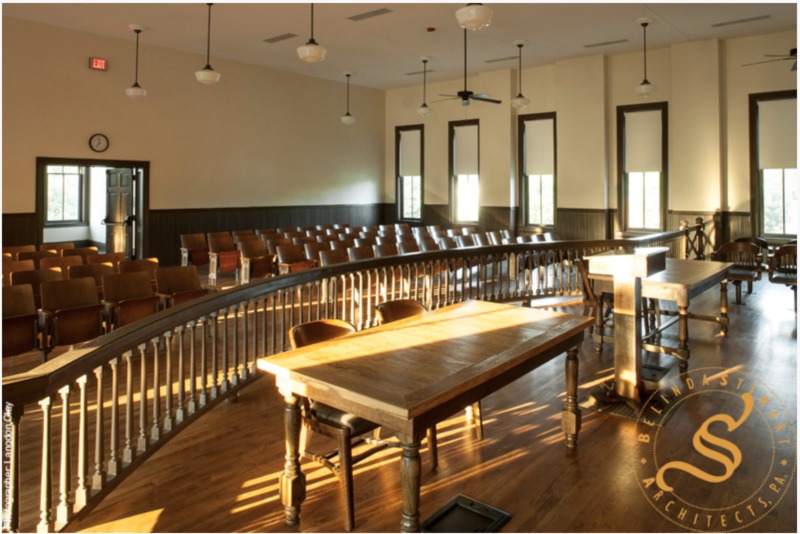
    <summary type="html"><![CDATA[<p><strong><em>For nearly 50 years, the murder of Emmett Till was not commemorated in Tallahatchie County. Even the courthouse itself hid the story. Only recently has the second district Tallahatchie County Courthouse been used to tell Till's story.</em></strong></p><img src="https://tillapp.emmett-till.org/files/fullsize/721ee5cdef8479da0d84c5dc3ca54680.jpg" alt="Courthouse interior after the Belinda Stewart Renovation " /><br/><p>On September 19, 1955, at 9:25 am, the trial of J. W. Milam and Roy Bryant for the murder of Emmett Till opened in this courthouse. It was a sensational, five-day trial. For the first time in history, the Northern press descended on a Mississippi trial. To this day, locals recall the spectacle that was the Till trial: the microphones, the cameras, the reporters, and the stifling heat of the second-floor courtroom. With approximately 400 people crowded into the small space (sitting in aisles and hanging out of windows), temperatures inside exceeded ninety degrees. For all these reasons, celebrated journalist David Halberstam, who attended the trial as a reporter for a West Point, MS newspaper, called the trial “the first great media event of the civil rights movement.”</p><p>The trial lasted a scant five days. It would have been even shorter, had the black press not managed to secure an extended recess on the second day of the trial. Baltimore Afro-American reporter James Hicks, Medgar Evers, and Mound Bayou’s Dr. T. R. M. Howard rounded up five witnesses that claimed (correctly) that Till was beaten (and possibly killed) by J. W. Milam and others in a barn outside of Drew, MS. Drew was 20 miles southwest in Sunflower County, and, if the witnesses were correct, the trial would have to be moved to the neighboring county. Judge Curtis Swango called a recess to investigate the possibility. In the end, the witnesses were not believed and the trial was not moved.</p><p>On Friday, September 23, the all-white jury took only 67 minutes to deliberate before returning a verdict of not guilty. It was widely reported that the only reason it took them as long as it did was that they drank some Cokes in order to make it appear as if they were struggling with the decision.</p><p>The Cokes notwithstanding, the jury did not struggle to reach a verdict. They believed (or at least they said they did) the testimony of Sheriff H. C. Strider, Harry D. Malone, and Dr. L. B. Otken—all of whom argued that the body could not be positively identified as Emmett Till. The body was so badly decomposed by the time it was retrieved from the Tallahatchie River, these men argued, that the race of the body could not be determined. And, if the race of the body could not be determined, there was no way to verify that the body was Emmett Till. Thus were the murderers acquitted.</p><p>The testimonies of these men are deeply suspect. Malone never saw the body (although he claimed he did), and Strider changed his mind in dramatic fashion. A month earlier, when the Sheriff pulled Till’s body from the water, he marked the death certificate “colored” and sent the body to Chester Miller’s Century Burial Funeral Home—the black funeral home in Greenwood. His later suggestion, under oath, that the body was so decomposed that its race could not be determined was nothing more than a lie to secure an acquittal.</p><p>On July 1, 1972, the Tallahatchie County Board of Supervisors announced that the Courthouse in Sumner would be renovated by Yazoo City architect Jack DeCell. In the name of modernization, and at a cost of $235,000, the chairs were replaced with pews, the sash windows were replaced with solid glass, interior walls were added to the courtroom to shrink the space by over 800 square feet, and the courtroom was painted purple. The renovations were so dramatic that some locals believe the DeCell renovation was intended to bury all memory of Till’s murder. Those who believe this are quick to note that it was during the DeCell renovation that the cotton gin fan that once anchored Till’s body was lost.</p><p>In 1990, the Sumner courthouse was listed on the state register of historic places. Curiously, the historic places nomination makes no mention of the Till murder. The courthouse is nominated only for architectural reasons. The courthouse, the state claimed, is one of a very few remaining examples of Richardsonian Romanesque architecture. For some, this focus on architecture and the complete silence on the famous trial seemed like yet another attempt to forget Till’s murder.</p><p>Beginning in 2005, the Emmett Till Memorial Commission set out to undo the work of DeCell and the historical nomination. By renovating the courthouse to its 1955 condition, the Commission shifted the primary narrative of the courthouse. It was no longer about architecture; it was about race, memory, and justice. In this spirit, the Commission organized a formal apology to the Till family from the county in 2007.</p><p>In 2015, the space reopened, both as an operating courthouse and a living memorial to the Till murder. The renovation was done by Belinda Stewart Architects of Eupora.</p><p><em><strong><a href="https://tillapp.emmett-till.org/items/show/9">For more (including 11 images&#32;&amp;&#32;1 video) view the original article</a></strong></em></p>]]></summary>
    <published>2019-07-17T10:34:54+00:00</published>
    <updated>2026-04-17T19:39:38+00:00</updated>
    <link rel="alternate" type="text/html" href="https://tillapp.emmett-till.org/items/show/9"/>
    <id>https://tillapp.emmett-till.org/items/show/9</id>
    <author>
      <name>Dave Tell </name>
    </author>
  </entry>
</feed>
