<?xml version="1.0" encoding="UTF-8"?>
<feed xmlns="http://www.w3.org/2005/Atom">
  <title type="text">Emmett Till Memory Project</title>
  <updated>2026-04-17T19:39:38+00:00</updated>
  <generator uri="http://framework.zend.com" version="1.12.20">Zend_Feed_Writer</generator>
  <link rel="alternate" type="text/html" href="https://tillapp.emmett-till.org/"/>
  <link rel="self" type="application/atom+xml" href="https://tillapp.emmett-till.org/items/browse?output=rss2"/>
  <id>https://tillapp.emmett-till.org/</id>
  <author>
    <name>Emmett Till Memory Project</name>
    <uri>https://tillapp.emmett-till.org</uri>
  </author>
  <link rel="hub" href="https://pubsubhubbub.appspot.com/"/>
  <entry>
    <title type="html"><![CDATA[Burr Oak Cemetery: Till&#039;s final resting spot has never been without drama]]></title>
    <summary type="html"><![CDATA[<img src="https://tillapp.emmett-till.org/files/fullsize/8140b541508b18acace2bf2dc62169d4.jpg" alt="Emmett Till Headstone" /><br/><p>Emmett Till’s funeral began shortly after his body came home to Chicago. The A. A. Rayner Funeral home opened its doors for the initial viewing on Friday, September 2. On Sunday, Till's body was moved to the Robert’s Temple of the Church of God in Christ for a deeply emotional service. The church remained open for two days as a steady stream of people came to pay their last respects—one hundred thousand of them, according to the police estimate. After final prayers on Tuesday morning, fifty cars followed Emmett’s hearse to the burial ground at Burr Oak Cemetery.</p><p>In midcentury Chicago, death was just as segregated as life. Burr Oak Cemetery was founded in 1927 in Alsip, Illinois, a suburb of Chicago, financed by prominent south-side businessmen as a final resting place for African-Americans. Famous contemporaries of Emmett Till were buried there including heavyweight boxing champion Ezzard Charles, songwriter/producer Willie Dixon, gospel singer Roberta Martin, and Dinah Washington, “the queen of the blues.”</p><p>It was warm even for early September when Emmett Till’s body was laid to rest in Burr Oak. Two hundred people gathered at the gravesite for one last round of tears and prayer and remembrance. His ground level marker read simply, “Emmett Till, In Loving Memory” along with the dates of his birth and death, and a tiny photo of him from Christmas, 1954. As the decades passed, Mamie Till-Mobley was increasingly dissatisfied with the conditions and upkeep of the grounds. Till's gravesite was often flooded, the headstone was broken by mowers, the picture was in tatters, and the vase designed to hold flowers would no longer stand upright. She longed to move the body to the beautiful Oak Woods Cemetery and established a fundraising campaign to make it happen.</p><p>In 2001, however, Burr Oak Cemetery came under new management. Under the direction of Carolyn Towns, the cemetery satisfied Till-Mobley with a promise to build a museum called the “Emmett Till Historical Museum.” The museum would honor the legacy of Emmett and provide a final resting spot for him, Till-Mobley, and her long-time husband Gene Mobley. It never came to pass.</p><p>In May 2004, nearly fifty years after his burial, the FBI reopened the Till case. The Cook County Medical Examiner set up a tent at Burr Oak Cemetery and exhumed Till’s body. The forensic exam determined that the body in Burr Oak Cemetery was in fact the body of Emmett Till. While this may seem obvious, it is important to remember that there was a dispute over the identity of the body that, in 1955, provided the jury the legal cover with which to acquit the murderers. Although Sheriff H. C. Strider indicated that Till was “colored” on the death certificate, he testified in trial that the body was so decomposed that he could not identify its race. This was willed ignorance, designed to provide a legal mechanism to let the murderers walk free. With this background, the 2005 exhumation takes on new importance. The forensic exam marked the end of Strider’s racist lie.</p><p>Three days after the FBI exhumed the body, they set the body in a new coffin and, in a private ceremony, reinterred the body. Because the long-promised Emmett Till Historical Museum had not yet come to pass, the family understood the reburial as a temporary measure. When the museum was complete, they believed Till’s body would be moved once more.</p><p>In July 2009, Carolyn Towns was charged with dismembering remains, reselling occupied plots, and stealing over $100,000 from the cemetery. She pled guilty to a range of charges in 2011 and began a twelve-year prison sentence in November of that year.</p><p>Although Till’s plot was not harmed by Town’s scheme, she had not cared for Till’s casket. Following the exhumation, the original casket sat in a neglected storage shed and was occupied by a family of possums. When it was discovered in 2009, the Till family took possession of the casket, had it restored at A. A. Rayner and Sons funeral home, and made plans to give it to Smithsonian’s National Museum of African American History and Culture.</p><p>Beautifully refurbished, that original coffin where Emmett’s body lay while one-hundred-thousand mourners passed by, where the famous photograph of his brutalized face was taken, where he rested for fifty years, now forms the centerpiece of the most moving display in the National Museum of African American History and Culture in Washington, D. C. With the coffin front and center, the visitor enters a room designed to look like the Roberts Temple did in September 1955.</p><p>While the original coffin has moved to Washington, D. C., Till remains in Burr Oak Cemetery, where he was first buried in 1955. The headstone is small and relatively unadorned, the museum remains unbuilt, but the gravesite is peaceful and open to public viewing.</p><p><em><strong><a href="https://tillapp.emmett-till.org/items/show/21">For more (including 6 images&#32;&amp;&#32;1 video) view the original article</a></strong></em></p>]]></summary>
    <published>2020-01-24T16:34:50+00:00</published>
    <updated>2026-04-17T19:39:38+00:00</updated>
    <link rel="alternate" type="text/html" href="https://tillapp.emmett-till.org/items/show/21"/>
    <id>https://tillapp.emmett-till.org/items/show/21</id>
    <author>
      <name>Elliott Gorn&amp;#32;&amp;amp;&amp;#32;Dave Tell </name>
    </author>
  </entry>
  <entry>
    <title type="html"><![CDATA[Sumner Courthouse: The Trial, the Architecture, the Controversy]]></title>
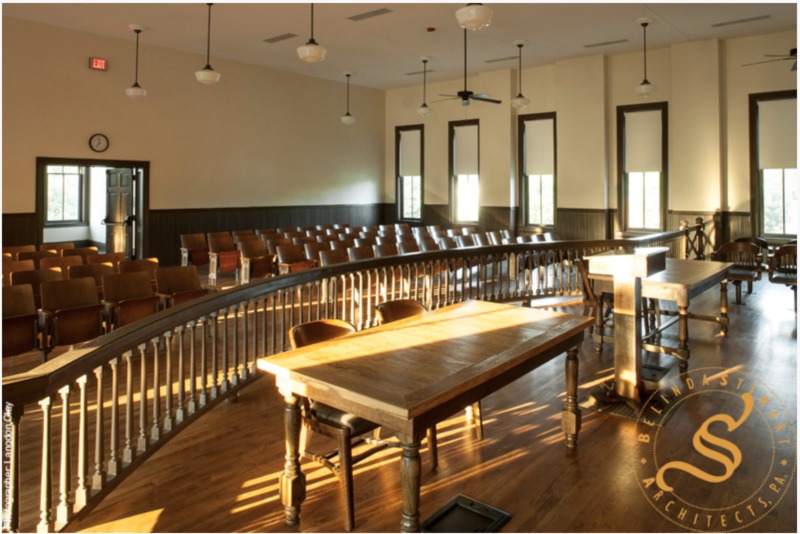
    <summary type="html"><![CDATA[<p><strong><em>For nearly 50 years, the murder of Emmett Till was not commemorated in Tallahatchie County. Even the courthouse itself hid the story. Only recently has the second district Tallahatchie County Courthouse been used to tell Till's story.</em></strong></p><img src="https://tillapp.emmett-till.org/files/fullsize/721ee5cdef8479da0d84c5dc3ca54680.jpg" alt="Courthouse interior after the Belinda Stewart Renovation " /><br/><p>On September 19, 1955, at 9:25 am, the trial of J. W. Milam and Roy Bryant for the murder of Emmett Till opened in this courthouse. It was a sensational, five-day trial. For the first time in history, the Northern press descended on a Mississippi trial. To this day, locals recall the spectacle that was the Till trial: the microphones, the cameras, the reporters, and the stifling heat of the second-floor courtroom. With approximately 400 people crowded into the small space (sitting in aisles and hanging out of windows), temperatures inside exceeded ninety degrees. For all these reasons, celebrated journalist David Halberstam, who attended the trial as a reporter for a West Point, MS newspaper, called the trial “the first great media event of the civil rights movement.”</p><p>The trial lasted a scant five days. It would have been even shorter, had the black press not managed to secure an extended recess on the second day of the trial. Baltimore Afro-American reporter James Hicks, Medgar Evers, and Mound Bayou’s Dr. T. R. M. Howard rounded up five witnesses that claimed (correctly) that Till was beaten (and possibly killed) by J. W. Milam and others in a barn outside of Drew, MS. Drew was 20 miles southwest in Sunflower County, and, if the witnesses were correct, the trial would have to be moved to the neighboring county. Judge Curtis Swango called a recess to investigate the possibility. In the end, the witnesses were not believed and the trial was not moved.</p><p>On Friday, September 23, the all-white jury took only 67 minutes to deliberate before returning a verdict of not guilty. It was widely reported that the only reason it took them as long as it did was that they drank some Cokes in order to make it appear as if they were struggling with the decision.</p><p>The Cokes notwithstanding, the jury did not struggle to reach a verdict. They believed (or at least they said they did) the testimony of Sheriff H. C. Strider, Harry D. Malone, and Dr. L. B. Otken—all of whom argued that the body could not be positively identified as Emmett Till. The body was so badly decomposed by the time it was retrieved from the Tallahatchie River, these men argued, that the race of the body could not be determined. And, if the race of the body could not be determined, there was no way to verify that the body was Emmett Till. Thus were the murderers acquitted.</p><p>The testimonies of these men are deeply suspect. Malone never saw the body (although he claimed he did), and Strider changed his mind in dramatic fashion. A month earlier, when the Sheriff pulled Till’s body from the water, he marked the death certificate “colored” and sent the body to Chester Miller’s Century Burial Funeral Home—the black funeral home in Greenwood. His later suggestion, under oath, that the body was so decomposed that its race could not be determined was nothing more than a lie to secure an acquittal.</p><p>On July 1, 1972, the Tallahatchie County Board of Supervisors announced that the Courthouse in Sumner would be renovated by Yazoo City architect Jack DeCell. In the name of modernization, and at a cost of $235,000, the chairs were replaced with pews, the sash windows were replaced with solid glass, interior walls were added to the courtroom to shrink the space by over 800 square feet, and the courtroom was painted purple. The renovations were so dramatic that some locals believe the DeCell renovation was intended to bury all memory of Till’s murder. Those who believe this are quick to note that it was during the DeCell renovation that the cotton gin fan that once anchored Till’s body was lost.</p><p>In 1990, the Sumner courthouse was listed on the state register of historic places. Curiously, the historic places nomination makes no mention of the Till murder. The courthouse is nominated only for architectural reasons. The courthouse, the state claimed, is one of a very few remaining examples of Richardsonian Romanesque architecture. For some, this focus on architecture and the complete silence on the famous trial seemed like yet another attempt to forget Till’s murder.</p><p>Beginning in 2005, the Emmett Till Memorial Commission set out to undo the work of DeCell and the historical nomination. By renovating the courthouse to its 1955 condition, the Commission shifted the primary narrative of the courthouse. It was no longer about architecture; it was about race, memory, and justice. In this spirit, the Commission organized a formal apology to the Till family from the county in 2007.</p><p>In 2015, the space reopened, both as an operating courthouse and a living memorial to the Till murder. The renovation was done by Belinda Stewart Architects of Eupora.</p><p><em><strong><a href="https://tillapp.emmett-till.org/items/show/9">For more (including 11 images&#32;&amp;&#32;1 video) view the original article</a></strong></em></p>]]></summary>
    <published>2019-07-17T10:34:54+00:00</published>
    <updated>2026-04-17T19:39:38+00:00</updated>
    <link rel="alternate" type="text/html" href="https://tillapp.emmett-till.org/items/show/9"/>
    <id>https://tillapp.emmett-till.org/items/show/9</id>
    <author>
      <name>Dave Tell </name>
    </author>
  </entry>
</feed>
