<?xml version="1.0" encoding="UTF-8"?>
<feed xmlns="http://www.w3.org/2005/Atom">
  <title type="text">Emmett Till Memory Project</title>
  <updated>2026-08-27T17:07:02+00:00</updated>
  <generator uri="http://framework.zend.com" version="1.12.20">Zend_Feed_Writer</generator>
  <link rel="alternate" type="text/html" href="https://tillapp.emmett-till.org/"/>
  <link rel="self" type="application/atom+xml" href="https://tillapp.emmett-till.org/items/browse?output=rss2"/>
  <id>https://tillapp.emmett-till.org/</id>
  <author>
    <name>Emmett Till Memory Project</name>
    <uri>https://tillapp.emmett-till.org</uri>
  </author>
  <link rel="hub" href="https://pubsubhubbub.appspot.com/"/>
  <entry>
    <title type="html"><![CDATA[Robert&#039;s Temple Church of God in Christ : It was in Chicago that the Emmett Till lynching became a world-wide story ]]></title>
    <summary type="html"><![CDATA[<img src="https://tillapp.emmett-till.org/files/fullsize/1a5bbfe1683d2e97e5a91eb748ed1e3b.jpg" alt="Crowds outside Robert&#039;s Temple Church of God in Christ" /><br/><p>Hours after Till’s body was discovered protruding from the Tallahatchie River, Mississippi authorities began to bury the body—and the story—in a rural cemetery at a rural church deep in the Mississippi Delta. Had Till’s mother Mamie Till-Mobley not intervened and reclaimed her son’s body, Till’s lynching may have been recorded in the history books alongside the likes of George Lee and Lamar Smith. Like Till, Lee and Smith were lynched in Mississippi in the summer of 1955. Unlike Till, their stories have been largely forgotten. The difference in their respective fates can be traced to Mamie Till-Mobley's demand that the "world see" what happened to her son. It was at Robert’s Temple Church of God in Christ that the world saw. As Yvette Johnson wrote in the <em>Song and the Silence</em>, Mamie Till-Mobley changed the world with the open-casket funeral.</p><p>Upon arriving back in Chicago on the morning of September 2, 1955, the first stop for Till’s body was the A. A. Rayner Funeral home which, in 1955, was located at the corner of 41st and Cottage Grove. The casket arrived locked, sealed with the state seal of Mississippi, and accompanied by orders that the casket was not to be opened. If Mississippi authorities could not bury the body in a nameless cotton field, they hoped their seal would keep Till’s story under wraps. It did not work. </p><p>Till-Mobley disregarded the order and insisted that the casket be opened. It was at A. A. Rayner Funeral Home that she uttered the famous phrase: “Let the world see what they did to my boy.” Following Mamie's wishes, Rayner placed the body in the front room of their facility in a glass-topped casket. Over the next two days, as many as fifty thousand people would visit the funeral home to pay their respects.</p><p>Among the throngs at the funeral home was the photographer David Jackson. Jackson was a photographer for Johnson Publications, and Till-Mobley allowed him to be on the podium at the twelfth street station when Till’s body arrived. He then accompanied the body to Rayner and, when Till-Mobley opened the casket, he took a picture and published it in Johnson Publication’s leading outlets: <em>Jet</em> and the <em>Chicago Defender</em>. In a way that words could never do, Jackson’s photograph captured the sheer violence visited on the body—and especially the face—of Emmett Till. Although the brutality of the picture is difficult to describe, the words of John Edgar Wideman come close. He described a face “crushed, chewed, [and] mutilated.” A face “with all the boy, all the human being battered out of it.” Jackson’s photograph transformed the Till murder from one more 1955 Mississippi lynching into the unforgettable spark of the civil rights movement. Delta activist Amzie Moore may have put it best, claiming that the photograph made Till’s murder “the best advertised lynching I had ever heard.” </p><p>For black Chicago, however, the Jackson photograph was only the beginning. On Sunday, September 4th, the body was moved to the Robert’s Temple Church of God in Christ—the home congregation of Mamie Till and her mother Alma. The two-thousand seat auditorium was filled to capacity for the funeral, and several thousand more listened to the 90-minute service on loudspeakers set up outside the church. The sermon was given by Bishop Louis Ford, who used the funeral to call on President Eisenhower to “go into the Southern states and tell the people there . . . that unless the Negro gets full freedom in America, it is impossible for us to be leaders in the rest of the world.” He closed the sermon by announcing that the burial would be delayed until Tuesday and the body would lay in state for the next two days. </p><p>The following 48 hours saw an estimated one-hundred thousand mourners file past the body. </p><p>In 1991, Robert’s Temple Church of God in Christ underwent a major renovation. The iconic cross-shaped marquis was removed, a tan brick facade was installed over the top of the original storefront, an angular roofline hid the original curved profile, a drop-ceiling was installed, and the balcony was removed.</p><p>On March 29, 2006, Robert’s Temple was designated as a Chicago Landmark. The small plaque on the west side of the building is the only visible acknowledgement of the church’s key role in the Till story.</p><p><em><strong><a href="https://tillapp.emmett-till.org/items/show/20">For more (including 10 images&#32;&amp;&#32;1 video) view the original article</a></strong></em></p>]]></summary>
    <published>2020-01-24T16:12:06+00:00</published>
    <updated>2026-04-17T19:39:38+00:00</updated>
    <link rel="alternate" type="text/html" href="https://tillapp.emmett-till.org/items/show/20"/>
    <id>https://tillapp.emmett-till.org/items/show/20</id>
    <author>
      <name>Dave Tell</name>
    </author>
  </entry>
  <entry>
    <title type="html"><![CDATA[Sumner Courthouse: The Trial, the Architecture, the Controversy]]></title>
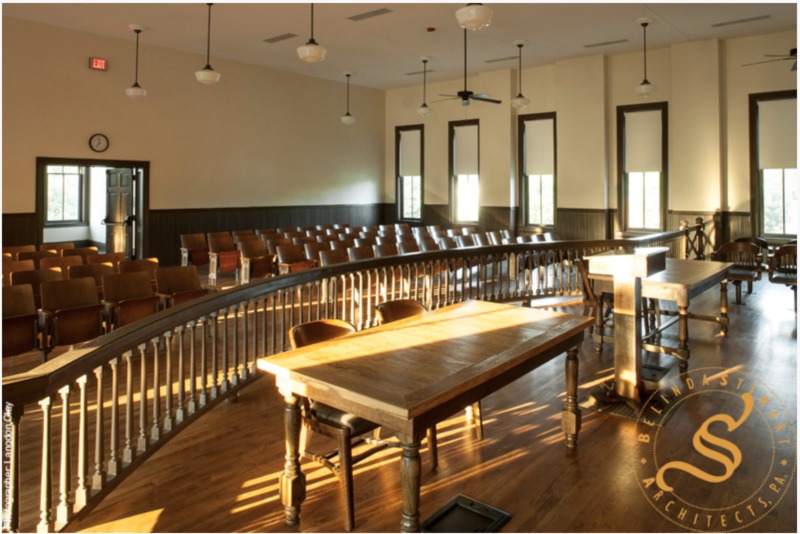
    <summary type="html"><![CDATA[<p><strong><em>For nearly 50 years, the murder of Emmett Till was not commemorated in Tallahatchie County. Even the courthouse itself hid the story. Only recently has the second district Tallahatchie County Courthouse been used to tell Till's story.</em></strong></p><img src="https://tillapp.emmett-till.org/files/fullsize/721ee5cdef8479da0d84c5dc3ca54680.jpg" alt="Courthouse interior after the Belinda Stewart Renovation " /><br/><p>On September 19, 1955, at 9:25 am, the trial of J. W. Milam and Roy Bryant for the murder of Emmett Till opened in this courthouse. It was a sensational, five-day trial. For the first time in history, the Northern press descended on a Mississippi trial. To this day, locals recall the spectacle that was the Till trial: the microphones, the cameras, the reporters, and the stifling heat of the second-floor courtroom. With approximately 400 people crowded into the small space (sitting in aisles and hanging out of windows), temperatures inside exceeded ninety degrees. For all these reasons, celebrated journalist David Halberstam, who attended the trial as a reporter for a West Point, MS newspaper, called the trial “the first great media event of the civil rights movement.”</p><p>The trial lasted a scant five days. It would have been even shorter, had the black press not managed to secure an extended recess on the second day of the trial. Baltimore Afro-American reporter James Hicks, Medgar Evers, and Mound Bayou’s Dr. T. R. M. Howard rounded up five witnesses that claimed (correctly) that Till was beaten (and possibly killed) by J. W. Milam and others in a barn outside of Drew, MS. Drew was 20 miles southwest in Sunflower County, and, if the witnesses were correct, the trial would have to be moved to the neighboring county. Judge Curtis Swango called a recess to investigate the possibility. In the end, the witnesses were not believed and the trial was not moved.</p><p>On Friday, September 23, the all-white jury took only 67 minutes to deliberate before returning a verdict of not guilty. It was widely reported that the only reason it took them as long as it did was that they drank some Cokes in order to make it appear as if they were struggling with the decision.</p><p>The Cokes notwithstanding, the jury did not struggle to reach a verdict. They believed (or at least they said they did) the testimony of Sheriff H. C. Strider, Harry D. Malone, and Dr. L. B. Otken—all of whom argued that the body could not be positively identified as Emmett Till. The body was so badly decomposed by the time it was retrieved from the Tallahatchie River, these men argued, that the race of the body could not be determined. And, if the race of the body could not be determined, there was no way to verify that the body was Emmett Till. Thus were the murderers acquitted.</p><p>The testimonies of these men are deeply suspect. Malone never saw the body (although he claimed he did), and Strider changed his mind in dramatic fashion. A month earlier, when the Sheriff pulled Till’s body from the water, he marked the death certificate “colored” and sent the body to Chester Miller’s Century Burial Funeral Home—the black funeral home in Greenwood. His later suggestion, under oath, that the body was so decomposed that its race could not be determined was nothing more than a lie to secure an acquittal.</p><p>On July 1, 1972, the Tallahatchie County Board of Supervisors announced that the Courthouse in Sumner would be renovated by Yazoo City architect Jack DeCell. In the name of modernization, and at a cost of $235,000, the chairs were replaced with pews, the sash windows were replaced with solid glass, interior walls were added to the courtroom to shrink the space by over 800 square feet, and the courtroom was painted purple. The renovations were so dramatic that some locals believe the DeCell renovation was intended to bury all memory of Till’s murder. Those who believe this are quick to note that it was during the DeCell renovation that the cotton gin fan that once anchored Till’s body was lost.</p><p>In 1990, the Sumner courthouse was listed on the state register of historic places. Curiously, the historic places nomination makes no mention of the Till murder. The courthouse is nominated only for architectural reasons. The courthouse, the state claimed, is one of a very few remaining examples of Richardsonian Romanesque architecture. For some, this focus on architecture and the complete silence on the famous trial seemed like yet another attempt to forget Till’s murder.</p><p>Beginning in 2005, the Emmett Till Memorial Commission set out to undo the work of DeCell and the historical nomination. By renovating the courthouse to its 1955 condition, the Commission shifted the primary narrative of the courthouse. It was no longer about architecture; it was about race, memory, and justice. In this spirit, the Commission organized a formal apology to the Till family from the county in 2007.</p><p>In 2015, the space reopened, both as an operating courthouse and a living memorial to the Till murder. The renovation was done by Belinda Stewart Architects of Eupora.</p><p><em><strong><a href="https://tillapp.emmett-till.org/items/show/9">For more (including 11 images&#32;&amp;&#32;1 video) view the original article</a></strong></em></p>]]></summary>
    <published>2019-07-17T10:34:54+00:00</published>
    <updated>2026-04-17T19:39:38+00:00</updated>
    <link rel="alternate" type="text/html" href="https://tillapp.emmett-till.org/items/show/9"/>
    <id>https://tillapp.emmett-till.org/items/show/9</id>
    <author>
      <name>Dave Tell </name>
    </author>
  </entry>
  <entry>
    <title type="html"><![CDATA[Graball Landing: Locals believe that Till was pulled from the river at this site ]]></title>
    <summary type="html"><![CDATA[<p><strong><em>This oft-vandalized site has become the center of a national conversation on race and vandalism. Signs from this spot have been stolen, replaced, shot, replaced again, and shot again. One of the signs ended up at the Smithsonian's National Museum of American History; a second sign is now touring the country as part of a traveling exhibit created by the Children's Museum of Indianapolis. </em></strong></p><img src="https://tillapp.emmett-till.org/files/fullsize/7255707ed6a04c2be2e9b7fe18c462bc.jpg" alt="The bullet proof sign at Graball Landing, just after its October 2019 dedication" /><br/><p>Graball Landing sits at the confluence of the Tallahatchie River and the Black Bayou. Many locals believe that it is the site where Till’s body was recovered from the Tallahatchie River. Since April 2008, the site has become the focus of national controversy as the Emmett Till Memorial Commission’s (ETMC) attempts to commemorate the landing have been met by repeated vandalism.</p><p>It is difficult to say with certainty where the body was recovered. In 1955, there was widespread agreement that the body was found near Pecan Point, a few miles downstream from this spot. In 2006, the FBI concluded that Till’s body was discovered several miles downstream at a spot where the Tallahatchie River briefly dips into Leflore County. After being pulled into a boat, the body was then brought to Fish Lake Landing (very near Pecan Point) where it was finally removed from the water.</p><p>Regardless of whether or not Graball Landing is the correct site, the local belief in the validity of this site has made the landing a nationally recognized (and nationally contested) memory site.</p><p>The ETMC first commemorated this site in 2008, erecting a sign that claimed, unequivocally, “this is the site where Till’s body was removed from the river.” Within six months, the sign was stolen and thrown into the river. This was the first instance of what would become a repeated problem: vandalism. A second sign quickly replaced the first, but it was quickly filled with bullet holes.</p><p>In 2016, NYU student Kevin Wilson happened on the shot-up sign. He posted it to Facebook and, within days, the vandalism was covered by every major media outlet in the country.</p><p>The media coverage generated intense moral outrage and a widespread demand to replace the sign. When the big-hearted Brooklyn sign manufacturer Lite Brite Neon volunteered to fabricate, ship, and install a new marker free of charge, the Commission quickly cut down the old sign to make room for the new one.</p><p>But without waiting for the Lite Brite sign to be fabricated, the ETMC bought a third a sign, identical to the first two, and dedicated it on June 21, 2018. It lasted only 35 days before it, too, was shot. And then, sometime between July 27, 2018 and September 10, 2018, three Ole Miss fraternity brothers posed in front of it with guns, trophy style. Shortly after news of the fraternity brother's publicity stunt, the ETMC took down the third sign.</p><p>The fourth sign was dedicated on October 19, 2019.</p><p>The fourth sign was crafted by Lite Brite Neon. As was widely reported in the national press, it is bullet proof. It is made from 1/2" AR500 steel and covered with a 3/4" replaceable polycarbonate plate. Weighing in at nearly 500 lbs., the sign is designed to absorb a rifle round.</p><p>Unlike the first three signs, the language on bullet-proof sign addresses the history of vandalism directly. Believing that the bullet holes are part of Till’s story too, the new sign is designed to register the history of vandalism even as it resists future attempts to desecrate the site.</p><p>The ETMC never imagined that a bullet-proof sign would solve fundamental issues of racism. And it didn't. On November 2, 2019, white nationalists gathered at the site to film a promotional video.</p><p>The history of vandalism and activism centered on this site led ETMC founder Jerome Little to observe that Graball Landing is both a beacon of racial progress and a trenchant reminder of the progress yet to be made.</p><p><em><strong><a href="https://tillapp.emmett-till.org/items/show/6">For more (including 12 images&#32;&amp;&#32;1 video) view the original article</a></strong></em></p>]]></summary>
    <published>2019-07-16T15:15:50+00:00</published>
    <updated>2026-08-27T17:07:02+00:00</updated>
    <link rel="alternate" type="text/html" href="https://tillapp.emmett-till.org/items/show/6"/>
    <id>https://tillapp.emmett-till.org/items/show/6</id>
    <author>
      <name>Dave Tell </name>
    </author>
  </entry>
  <entry>
    <title type="html"><![CDATA[Bryant&#039;s Grocery &amp; Meat Market: The Long-Ignored Site Where the Civil Rights Movement Started ]]></title>
    <summary type="html"><![CDATA[<p><strong><em>It was at Bryant's Grocery & Meat Market that Emmett Till whistled at Carolyn Bryant and jump-started the American Civil Rights Movement. But the building has been allowed to fall into ruin. Worse still, civil rights money intended to restore civil rights sites has been intentionally directed away from the building.</em></strong></p><img src="https://tillapp.emmett-till.org/files/fullsize/e249b45ffe3a44b723b372624bda8af4.jpg" alt="Bryant&#039;s Grocery and Meat Market " /><br/><p>On August 24, 1955, Emmett Till arrived at Bryant’s Grocery around 7:30 pm along with several cousins and friends. The primary attraction was the checkers game on the front porch. With his companions thus engaged, Till followed his cousin Wheeler Parker into the store. </p><p>When Wheeler came out of the store, Simeon Wright went in. Twelve years old, Wright grew up in the Mississippi Delta, knew the rules of the Jim Crow South, and didn't want to leave his Chicago cousin alone with white shopkeeper Carolyn Bryant. 
When Simeon entered the store, he saw nothing inappropriate. Contrary to the story later told in court by Carolyn Bryant, Till did not grab her or put his arms around her. He did not proposition her. He did not ask her for a date or call her "baby." He simply paid for his items and left the store. </p><p>Shortly after the cousins left the store, Carolyn Bryant came out too, heading for her car. That is when it happened. </p><p>Emmett whistled at Carolyn Bryant. As Simeon Wright remembers it, "It was a loud wolf whistle, a big-city 'whee wheeeee.'"  </p><p>Although historians have debated whether or not Till actually whistled, those who witnessed the event have always insisted that he did. Critically, Till's cousins Simeon Wright and Wheeler Parker (both eyewittnesses) insist that Till whistled. </p><p>The whistle violated the norms of the Jim Crow South, and Wright and Parker both knew it. It had broken an "unwritten law" that governed the interactions of black men and white women. Worried, they hurried Till away from the store as fast as possible. </p><p>The unwritten laws of the Jim Crow South were enforced through lynch mobs and vigilante violence. In this case, Carolyn’s husband Roy, his half-brother J. W. Milam, and an array of accomplices kidnapped Till, tortured him, shot him, attached his body to a cotton-gin fan with a length of barbed wire, and dropped his body in a river. </p><p>It is entirely fitting that, in 2020, when the US House of Representatives finally passed a federal antilynching bill, it was named the Emmett Till Antilynching Act. </p><p>For nothing more than a whistle, Till experienced the full fury of the Southern lynch mob. His innocence was answered by unimaginable violence. Indeed, the violence was so intense that it suggests a desperate effort to uphold the fading norms of white supremacy.</p><p>The effort did not work. Virtually every historian agrees that the Till murder jump-started the civil rights movement.  </p><p>While the brutal murder may have galvanized the movement, the grocery store has been allowed to fall into ruin. After the acquittal, the black sharecroppers that once kept Bryant’s Grocery in business refused their patronage, and the store was put up for sale less than a month after the trial. For the next three decades, the building was maintained as a country grocery by different owners—first as Wolfe’s and then as Young’s Grocery and Market. </p><p>Since the early 1980s, the site of Bryant’s Grocery & Meat Market has been owned by the Tribble family. Ray Tribble was a juror in the 1955 Till trial, and his children now own the site. In 2011, the Tribble family led the charge to renovate the adjacent gas station, Ben Roy’s Service Station. Although Ben Roy’s has no civil rights history, the family was able to leverage its proximity to Bryant’s Grocery to obtain money set aside for civil rights restoration. Unfortunately, the restored Ben Roy’s makes no mention of Till, the civil rights movement, or Bryant’s Grocery. </p><p>Several parties have offered to buy the property from the Tribbles in the interest of restoring it as a memory site. As of 2019, the Tribbles have refused to sell the property for less than $4 million. While the world sees Bryant’s Grocery as the origin of the civil rights movement, the Tribbles apparently see it as potentially valuable commercial property.</p><p><em><strong><a href="https://tillapp.emmett-till.org/items/show/1">For more (including 10 images&#32;&amp;&#32;1 video) view the original article</a></strong></em></p>]]></summary>
    <published>2019-07-15T20:10:38+00:00</published>
    <updated>2026-04-17T19:39:38+00:00</updated>
    <link rel="alternate" type="text/html" href="https://tillapp.emmett-till.org/items/show/1"/>
    <id>https://tillapp.emmett-till.org/items/show/1</id>
    <author>
      <name>Dave Tell</name>
    </author>
  </entry>
</feed>
