<?xml version="1.0" encoding="UTF-8"?>
<feed xmlns="http://www.w3.org/2005/Atom">
  <title type="text">Emmett Till Memory Project</title>
  <updated>2026-08-27T17:07:02+00:00</updated>
  <generator uri="http://framework.zend.com" version="1.12.20">Zend_Feed_Writer</generator>
  <link rel="alternate" type="text/html" href="https://tillapp.emmett-till.org/"/>
  <link rel="self" type="application/atom+xml" href="https://tillapp.emmett-till.org/items/browse?output=rss2"/>
  <id>https://tillapp.emmett-till.org/</id>
  <author>
    <name>Emmett Till Memory Project</name>
    <uri>https://tillapp.emmett-till.org</uri>
  </author>
  <link rel="hub" href="https://pubsubhubbub.appspot.com/"/>
  <entry>
    <title type="html"><![CDATA[Homesite of J. W. Milam: The Site of an Influential Fiction]]></title>
    <summary type="html"><![CDATA[<img src="https://tillapp.emmett-till.org/files/fullsize/255df4a5e79d52c311a923999fa42f4e.jpg" alt="Tallahatchie Civil Rights Driving Tour sign, Milam&#039;s House. " /><br/><p>In 2008, the Emmett Till Memorial Commission (ETMC) erected a sign at this spot. Although nothing remains except an overgrown field, in 1955 this was the site of J.W. Milam's home and, critically, his shed.</p><p>The sign claims that Till was beaten here in the shed that once stood on this spot. This is not true.</p><p>When they wrote this sign, the ETMC was following the story told by <em>LOOK</em> magazine in January of 1956. Titled "The Shocking Story of Approved Killing in Mississippi," the <em>LOOK</em> article was one of the most influential versions of Till's story ever told. And it was virtually 100% false.</p><p>Since the murderers had already been acquitted in a court of law, <em>LOOK</em> magazine refused to print the story unless every named participant signed a waiver (see the documents for an example).</p><p>In fact, Till was tortured at the Seed Barn on the Milam Plantation in Sunflower County--27 miles west. But the barn was run by Leslie Milam (J.W.'s brother). Leslie did not sign a release form and could not be included in the story. So Huie moved the torture here, to J. W. Milams' shed in Glendora.</p><p>Ironically, barely 500 feet west of this sign is another ETMC sign commemorating King's Place, where the black journalist Jimmy Hicks learned about Levi "Too Tight" Collins and Henry Lee Loggins. But Collins and Loggins are only involved if the torture happened in Sunflower County. This means that the two signs, both erected by the ETMC in 2008, are mutually exclusive.</p><p>If Collins and Loggins were key witnesses, then King’s Place is a historic site but Milam’s shed is not. Alternately, if Milam’s shed is a historic site, then Collins and Loggins were red herrings and King’s Place was the site where the black press lost the story.</p><p><em><strong><a href="https://tillapp.emmett-till.org/items/show/15">For more (including 3 images) view the original article</a></strong></em></p>]]></summary>
    <published>2019-07-18T20:43:54+00:00</published>
    <updated>2026-04-17T19:39:38+00:00</updated>
    <link rel="alternate" type="text/html" href="https://tillapp.emmett-till.org/items/show/15"/>
    <id>https://tillapp.emmett-till.org/items/show/15</id>
    <author>
      <name>Dave Tell </name>
    </author>
  </entry>
  <entry>
    <title type="html"><![CDATA[Graball Landing: Locals believe that Till was pulled from the river at this site ]]></title>
    <summary type="html"><![CDATA[<p><strong><em>This oft-vandalized site has become the center of a national conversation on race and vandalism. Signs from this spot have been stolen, replaced, shot, replaced again, and shot again. One of the signs ended up at the Smithsonian's National Museum of American History; a second sign is now touring the country as part of a traveling exhibit created by the Children's Museum of Indianapolis. </em></strong></p><img src="https://tillapp.emmett-till.org/files/fullsize/7255707ed6a04c2be2e9b7fe18c462bc.jpg" alt="The bullet proof sign at Graball Landing, just after its October 2019 dedication" /><br/><p>Graball Landing sits at the confluence of the Tallahatchie River and the Black Bayou. Many locals believe that it is the site where Till’s body was recovered from the Tallahatchie River. Since April 2008, the site has become the focus of national controversy as the Emmett Till Memorial Commission’s (ETMC) attempts to commemorate the landing have been met by repeated vandalism.</p><p>It is difficult to say with certainty where the body was recovered. In 1955, there was widespread agreement that the body was found near Pecan Point, a few miles downstream from this spot. In 2006, the FBI concluded that Till’s body was discovered several miles downstream at a spot where the Tallahatchie River briefly dips into Leflore County. After being pulled into a boat, the body was then brought to Fish Lake Landing (very near Pecan Point) where it was finally removed from the water.</p><p>Regardless of whether or not Graball Landing is the correct site, the local belief in the validity of this site has made the landing a nationally recognized (and nationally contested) memory site.</p><p>The ETMC first commemorated this site in 2008, erecting a sign that claimed, unequivocally, “this is the site where Till’s body was removed from the river.” Within six months, the sign was stolen and thrown into the river. This was the first instance of what would become a repeated problem: vandalism. A second sign quickly replaced the first, but it was quickly filled with bullet holes.</p><p>In 2016, NYU student Kevin Wilson happened on the shot-up sign. He posted it to Facebook and, within days, the vandalism was covered by every major media outlet in the country.</p><p>The media coverage generated intense moral outrage and a widespread demand to replace the sign. When the big-hearted Brooklyn sign manufacturer Lite Brite Neon volunteered to fabricate, ship, and install a new marker free of charge, the Commission quickly cut down the old sign to make room for the new one.</p><p>But without waiting for the Lite Brite sign to be fabricated, the ETMC bought a third a sign, identical to the first two, and dedicated it on June 21, 2018. It lasted only 35 days before it, too, was shot. And then, sometime between July 27, 2018 and September 10, 2018, three Ole Miss fraternity brothers posed in front of it with guns, trophy style. Shortly after news of the fraternity brother's publicity stunt, the ETMC took down the third sign.</p><p>The fourth sign was dedicated on October 19, 2019.</p><p>The fourth sign was crafted by Lite Brite Neon. As was widely reported in the national press, it is bullet proof. It is made from 1/2" AR500 steel and covered with a 3/4" replaceable polycarbonate plate. Weighing in at nearly 500 lbs., the sign is designed to absorb a rifle round.</p><p>Unlike the first three signs, the language on bullet-proof sign addresses the history of vandalism directly. Believing that the bullet holes are part of Till’s story too, the new sign is designed to register the history of vandalism even as it resists future attempts to desecrate the site.</p><p>The ETMC never imagined that a bullet-proof sign would solve fundamental issues of racism. And it didn't. On November 2, 2019, white nationalists gathered at the site to film a promotional video.</p><p>The history of vandalism and activism centered on this site led ETMC founder Jerome Little to observe that Graball Landing is both a beacon of racial progress and a trenchant reminder of the progress yet to be made.</p><p><em><strong><a href="https://tillapp.emmett-till.org/items/show/6">For more (including 12 images&#32;&amp;&#32;1 video) view the original article</a></strong></em></p>]]></summary>
    <published>2019-07-16T15:15:50+00:00</published>
    <updated>2026-08-27T17:07:02+00:00</updated>
    <link rel="alternate" type="text/html" href="https://tillapp.emmett-till.org/items/show/6"/>
    <id>https://tillapp.emmett-till.org/items/show/6</id>
    <author>
      <name>Dave Tell </name>
    </author>
  </entry>
  <entry>
    <title type="html"><![CDATA[Black Bayou Bridge: Till&#039;s body may have been dropped in the water from this bridge.]]></title>
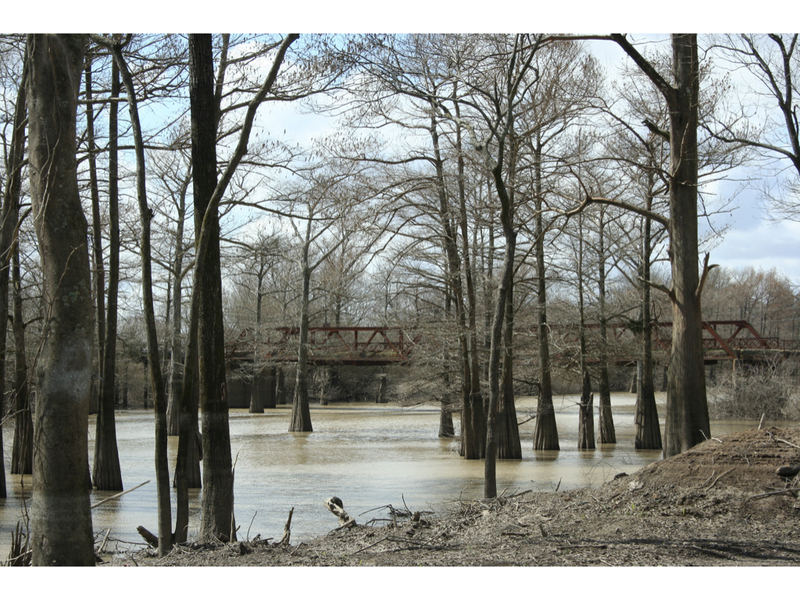
    <summary type="html"><![CDATA[<p><strong><em>Many people believe that this bridge may have been the spot that the body of Emmett Till was dropped into the water. Approximately two miles east of this spot, the Bayou spills into the Tallahatchie River. At the confluence of the two rivers is a site called Graball Landing; it is marked by an Emmett Till Memorial Commission sign as the site where Till’s body may have been recovered from the river. </em></strong></p><img src="https://tillapp.emmett-till.org/files/fullsize/157b85a15899602d261c7f26c1f702a5.jpg" alt="Black Bayou Bridge" /><br/><p>The strongest argument in favor of the theory that Till was thrown off this bridge and recovered at Graball Landing is its intuitiveness. This site is immediately adjacent to both J. W. Milam’s home (where Till’s clothes were burned) and the Glendora Cotton Gin (where they could have easily secured the fan with the help of Milam’s neighbor Elmer Kimbell, who worked at the gin). Because the murderers were in a race with daybreak to dispose of the body as quickly as possible, they certainly would have appreciated the proximity of this bridge. Heightening the credibility of this theory is the fact that this road was closed permanently sometime in 1955. 
Beyond the intuitive convenience of the theory, the Black Bayou Bridge theory has a strong advocate in Glendora Mayor Johnny B. Thomas. Thomas has used the Emmett Till Historic Intrepid Center (a Till museum just up the road) to advocate for this theory for years. </p><p>Thomas has a vested interest in this site. In 2010, the Mississippi Development Authority advised him that Emmett Till tourism represented the best chance at economic development for the town. The more the story of Till's murder centers on Glendora, the more tourists will have reason to come, and the more economic development will follow. </p><p>But quite apart from matters of tourism, Thomas does have an interesting story. He claims that his father was Henry Lee Loggins—Milam’s “right hand” man who was widely rumored to be personally involved in the murder.
According to African American journalist James L. Hicks, Loggins and Levi “Too Tight” Collins (both black men) were forced by J. W. Milam to participate in the torture and murder of Emmett Till before being jailed in Charleston on trumped up charges to keep them away from the investigation. Defense attorney J. J. Breland later confirmed that Loggins and Collins were held on false charges to prevent them from testifying. 
Although Loggins publicly denied all involvement his entire life (most publicly on <em>60 Minutes</em>), there are rumors that he made a deathbed confession to his son. If true, it means that Thomas’s claim that the body was thrown over this bridge might be based on Loggin's personal involvement.</p><p><em><strong><a href="https://tillapp.emmett-till.org/items/show/2">For more (including 5 images) view the original article</a></strong></em></p>]]></summary>
    <published>2019-07-15T21:15:51+00:00</published>
    <updated>2026-04-17T19:39:38+00:00</updated>
    <link rel="alternate" type="text/html" href="https://tillapp.emmett-till.org/items/show/2"/>
    <id>https://tillapp.emmett-till.org/items/show/2</id>
    <author>
      <name>Dave Tell </name>
    </author>
  </entry>
</feed>